
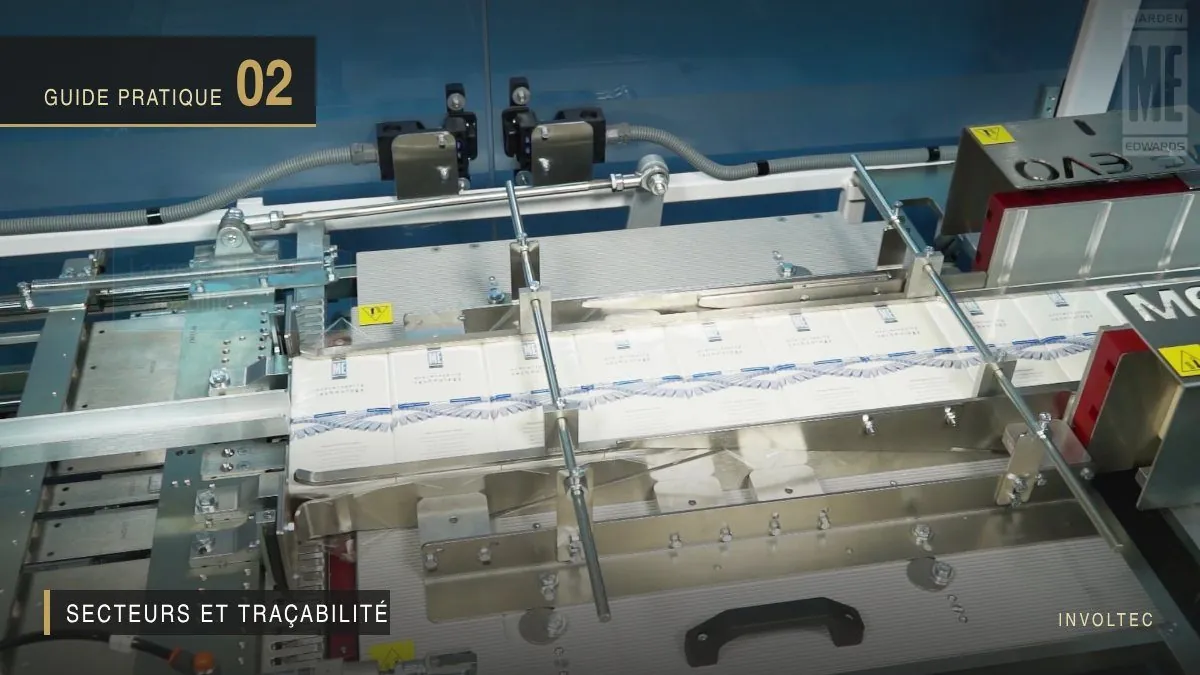
Scratches, material tension, format changeovers: what sets a cosmetics project apart from a standard one.
Overwrapping in perfumery and cosmetics: much more than just packaging
In the cosmetics and perfume industry, overwrapping is not simply a matter of applying a transparent film around a product. It is the last visible step in the manufacturing process and contributes directly to how the brand’s quality is perceived.
Even before discovering the fragrance or skincare product, the consumer looks at the packaging. Perfectly taut material, even folds and discreet seals immediately reinforce the image of quality. Conversely, creased material, an irregular seal or a scratch on the carton can undermine that perception, even if the product itself is flawless.
That is why the specifications we receive from perfume and cosmetics manufacturers go well beyond production output. Requirements also cover ergonomics, quality, maintainability, FAT (factory acceptance test)/SAT (site acceptance test) testing, documentation and integration of the machine into the line.
Read the rest of the guide
Enter your business contact details: you get immediate access to the whole of this guide and all INVOLTEC guides, on this device.
Coming up in the rest of the guide:
- Packaging quality that protects the brand image
- Not all cartons are the same
- The first defect is not always the one you think: scratches
- A packaging line, not a stand-alone machine
- Format changeovers: an economic issue
- The look of the material is part of the product
- … and 13 more sections
Packaging quality that protects the brand image
In the luxury and cosmetics sectors, packaging is an integral part of the product.

Consumers buy an experience as much as a fragrance.
Every detail counts:
- film transparency;
- fold quality;
- seal consistency;
- no bubbles or dog-ears;
- no scratches;
- perfect material geometry.
An overwrapping machine must therefore not only be able to produce fast; it must produce consistently, without spoiling the product’s presentation.
Not all cartons are the same
A common mistake is to regard a carton as a simple rectangular block.
In reality, perfume and cosmetics cartons are extremely varied:
- rigid boxes;
- sleeves;
- coated board;
- textured board;
- gloss or matt varnishes;
- laminates;
- hot-foil stamping;
- embossing;
- gilding;
- transparent windows.
Added to this are differences in grammage, rigidity and dimensions across product ranges. We find that the specifications we receive systematically take these variations into account, as well as the fragility of cartons and the coexistence of several formats on the same line.
Each material reacts differently to mechanical stress, which calls for suitably designed guides, conveyors and transfer systems.
The first defect is not always the one you think: scratches
When people talk about overwrapping quality, they often think of the seal.
Yet in practice, one of the most costly defects is scratching.
A single mark on a premium carton can lead to a product being downgraded.
These scratches rarely appear in the folding section. More often they come from:
- transfers between conveyors or between conveyors and elevators;
- product accumulation;
- poorly protected or poorly adjusted guides;
- materials unsuitable for contact with packaging;
- excessive pressure during speed changes.
The specifications we receive almost always call for stop systems in the event of accumulation, to avoid products rubbing against each other, as well as conveyor transfers designed not to damage cartons.
A packaging line, not a stand-alone machine
An overwrapping machine for perfume and cosmetics rarely works on its own.
It is usually installed between a cartoner and end-of-line equipment: labeller, serialisation equipment, case packer or conveying.
The quality of this integration is essential.
Poor synchronisation can cause:
- accumulation;
- impacts between products;
- nuisance stoppages;
- loss of output.
A good overwrapping machine must communicate with upstream and downstream equipment, adapt its operation automatically and protect products if the line becomes saturated. It is a requirement we see in almost every specification we receive.
Format changeovers: an economic issue
Perfume ranges evolve quickly. Runs are shorter and SKUs more numerous.
In this context, machine flexibility and fast format changeovers become competitive factors.
But a fast format changeover must not come at the expense of safety or quality.
The aim is to:
- limit the number of change parts;
- make them easy to handle;
- prevent assembly errors;
- guide settings through the HMI (human–machine interface);
- quickly recall validated parameters.
Some companies now set a format changeover target of under fifteen minutes, under good ergonomic conditions. It is an achievable target, provided you specify what is being measured: the useful time is the time between the last good product of the previous run and the first good product of the next, including cleaning and quality control. This definition, and this definition alone, makes it possible to compare two machines. Practical guide no. 8 details the measurement method and the levers for reducing it.
The look of the material is part of the product
On a premium gift box, the choice of material is not just a technical matter.
An unsuitable material is immediately visible on the shelf: wrong level of gloss, creases, a seal that is too conspicuous.
Several families coexist:
- gloss BOPP, which enhances colours and spot varnishes;
- matt BOPP, more understated, common on skincare ranges and men’s fragrances;
- coloured or opaque films, to enhance the packaging or conceal the contents;
- papers and bio-based materials, when the brand’s environmental approach takes priority.
Each family has its own sealing window and its own behaviour at speed.
Any change of material must therefore be validated on the machine, with the actual product, before marketing makes the final call.
Seal orientation: a fundamental choice
One technical point is often discovered too late: the position of the longitudinal seal.

Depending on the machine’s kinematics, this seal ends up either underneath the product or on its back face.
The choice depends on how the product will be displayed at the point of sale:
- a back seal for products displayed upright on the shelf, whose front face remains fully visible;
- an underneath seal for products packed in jars and for large gift boxes.
This parameter directly determines the choice of kinematics, and therefore of the machine range.
It must appear in the specification just like the output or the product dimensions.
Absorbing seasonal peaks
Cosmetics and perfume run to the rhythm of the year-end festive season, product launches and promotional campaigns.
On some lines, the workload varies threefold from one month to another.
Sizing production equipment for the annual peak means tying up capital that sits idle for much of the year.
There are two complementary solutions:
- renting a machine for the period of peak activity;
- acquiring an overhauled used machine to set up a second line.
In both cases, planning ahead is decisive: the format tooling for the SKUs concerned must be available before the campaign, not during it.
“All-servo” format changeover: a promise worth questioning
One argument comes up frequently in tenders: fully motorised format changeover, where the operator selects a recipe and the machine repositions itself.
The argument is attractive. It deserves close scrutiny, because its real-world performance depends on a condition that is rarely stated.
What a motorised format changeover actually does
The principle is to replace manual settings with motorised axes controlled from the interface. When a recipe is selected, each axis moves to the position stored for that format.
The machine therefore reproduces, very precisely, the position that was stored. That is both its strength and its limitation.
The rarely stated condition: dimensional stability of the cartons
A stored position is only correct if the incoming product matches the product used to store it.
Yet cartons vary. Board grammage, workshop humidity, production batch, a change of supplier: all of these shift the actual dimensions by a few tenths of a millimetre.
As long as the carton supplier keeps these variations under control, motorisation delivers on its promise. As soon as it no longer does, the recalled recipe no longer gives the right result, and the operator has to readjust the settings — on a machine that was precisely not designed to be adjusted by hand.
All-servo format changeover is therefore not, in itself, a guarantee of speed. It is a guarantee of repeatability, provided the product itself is repeatable.
Three situations in production
A stable carton range, a single supplier, monitored tolerances: motorisation brings a real, measurable gain.
A stable range but several suppliers with different tolerances: one recipe then has to be stored per format/supplier pair, which multiplies the number of recipes and complicates their management.
Uncontrolled dimensional variations: motorisation becomes a constraint, because it makes manual readjustment harder than on a machine with accessible settings.
The third case is the most common among manufacturers whose range changes quickly or whose cartons come from multiple sources.
The cost you don’t see at the time of purchase
Full motorisation comes at a price: the axes themselves, their maintenance and their re-homing. It adds components in an area where accessibility is already restricted.
It also shifts the skills required. An axis that loses its reference cannot be fixed with a spanner: it is fixed with a procedure, and often with the manufacturer.
Our takeaway
The right question is not “does the machine change format by itself?”, but “are my cartons stable enough for a stored position to still be correct in six months’ time?”
If the answer is yes, motorisation is a profitable investment. If it is no, or if nobody can answer, it is better to opt for accessible, marked and documented settings — and to work first on the dimensional control of the cartons with the supplier.
As with the adjustable consoles covered in practical guide no. 11, the decision is not driven by technology but by the specification: the nature of the range, stability of supply, frequency of batch changes and the level of repeatability required.
Ergonomics designed for production
A machine is used for several hours a day, over many years.
Every repetitive task therefore deserves particular attention.
Good ergonomics means, in particular:
- visual access to the key components;
- reels that are easy to reach and replace;
- accessible tooling;
- intuitive settings;
- guards, doors and format tooling that can be handled without tools wherever possible;
- cleaning areas that are easy to reach.
A simple intervention reduces downtime, improves operator comfort and contributes directly to line availability.
An HMI that supports operators
Industry faces constant staff turnover.
An effective human–machine interface should not merely display parameters; it should guide the user.
It should make it possible to:
- select a recipe quickly;
- guide format changeovers;
- display clear error messages;
- facilitate diagnostics;
- reduce training needs.
A clear HMI is often more effective than a highly sophisticated interface that is hard to get to grips with.
Maintenance: every minute counts
On a packaging line, the cost of a stoppage far exceeds that of the part being replaced.
A well-designed machine allows:
- quick access to wear components;
- immediate identification of components;
- safe maintenance operations;
- easy cleaning;
- a quick return to production.
It is this ease of intervention that helps maintain a high OEE (overall equipment effectiveness) over time.
10 criteria for choosing an overwrapping machine for perfume and cosmetics
Before selecting equipment, check in particular:
- Does the machine protect the cartons against scratches?
- Does the material stay perfectly taut at all speeds?
- Are the seals consistent across all formats?
- Are format changeovers simple and repeatable?
- Does the HMI guide the operators?
- Are the components easily accessible for maintenance?
- Does the machine communicate effectively with upstream and downstream equipment?
- Are emptying and cleaning operations quick?
- Does the manufacturer provide support for the FAT, the SAT and the ramp-up?
- Has the total cost of ownership been assessed beyond the purchase price?
Conclusion
Choosing an overwrapping machine for cosmetics or perfumery is not about selecting the fastest machine. It is about finding equipment that can preserve packaging quality over the long term, integrate smoothly into the production line and remain simple to operate day to day.
In an environment where every detail matters, the success of a project depends as much on the quality of the design as on the performance claimed by the manufacturer.