
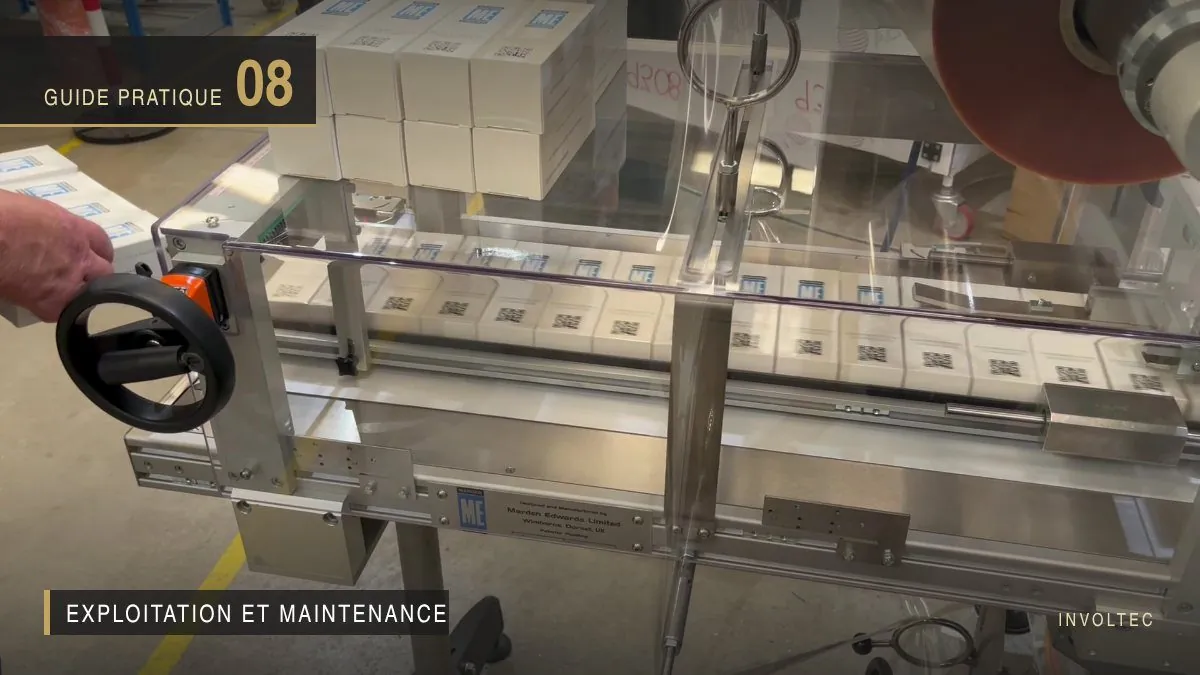
Fifteen minutes claimed, but measured how? What really determines the duration of a format changeover.
Format changeover: the production time that is often overlooked
When comparing two overwrapping machines, maximum output is often highlighted.
Yet in most workshops, stoppages due to format changeovers account for a large share of non-productive time.
The shorter the runs, the more frequent these changeovers become.
A company producing five SKUs a day does not face the same constraints as one making a single product for several weeks.
Today, with the proliferation of SKUs, limited editions and short runs, the speed and reliability of format changeovers have become key performance criteria.
A machine that restarts quickly, with repeatable settings, will often produce more over a year than a machine that is theoretically faster but slow to reconfigure.
Read the rest of the guide
Enter your business contact details: you get immediate access to the whole of this guide and all INVOLTEC guides, on this device.
Coming up in the rest of the guide:
- What is a format changeover?
- Adjustment or dedicated tooling: two very different situations
- What you need to provide to get a quote for a new format
- Fifteen minutes, but measured how?
- Change parts: simple… or a source of lost time
- The role of ergonomics
- … and 13 more sections
What is a format changeover?
A format changeover is not just a matter of replacing a few parts.
It generally includes:
- clearing the previous format
- stopping the machine;
- making the installation safe;
- removing the change parts;
- fitting the new parts;
- settings;
- trials;
- quality control;
- restarting production.
The time quoted by a manufacturer does not always cover all of these operations.
Before comparing two machines, it is therefore essential to check what is actually included.
Adjustment or dedicated tooling: two very different situations
Before talking about duration, you first need to know what type of changeover is involved. There are two cases, and they differ in both cost and lead time.

Simple adjustment.
If the new format remains within the range covered by the existing tooling, the operation is limited to repositioning the guides and adjusting the parameters.
This is the most favourable case, and the most common when the product range was planned in advance.
Dedicated tooling.
As soon as the dimensions fall outside the covered range, specific change parts become necessary: guides, templates and spacers adapted to the exact dimensions of the product.
These parts are made to order. Their lead time is an integral part of the project and must be built into the launch schedule for the new SKU.
This is why the cost of a format changeover is in fact decided much earlier: when the range of formats to be covered is defined at the time the machine is ordered. That is the moment to think broadly.
What you need to provide to get a quote for a new format
An incomplete quote request needlessly lengthens lead times. To determine whether an adjustment is enough, and if not to quote the tooling required, four items are essential:
- the exact dimensions of the product (length × width × height) and their actual manufacturing tolerances;
- the type of carton: board type, grammage, and any varnish, lamination or embossing;
- the machine model and serial number;
- the intended material web width or, failing that, a sample of the product to be packed.
The actual tolerances deserve particular attention: it is they, not the nominal dimensions, that determine how stable the setting will be.
A carton whose dimensions vary from one batch to the next will require readjustment at every batch change, however good the machine.
Fifteen minutes, but measured how?
Fifteen minutes is an achievable target, and more and more manufacturers are writing it into their specifications — practical guide no. 2 returns to this for cosmetics lines.
So the figure itself is not in question. What needs checking is what it actually measures.
Manufacturers sometimes claim very fast format changeovers.
But several questions need to be asked:
- Is this time measured by an experienced technician or by a production operator?
- Does it include cleaning the machine?
- Does it include the quality check on the first product?
- Does it account for replacing all the change parts?
- Is the restart included in the calculation?
The time that really matters is the time between the last compliant product of the previous run and the first compliant product of the next run.
It is this time that directly affects line availability.
Change parts: simple… or a source of lost time
Not all change parts are equal.
Good design should favour:
- lightweight parts;
- intuitive fitting;
- poka-yoke features to prevent errors;
- positioning marks;
- clearly identified storage.
- But above all, parts in good condition
Every hesitation during fitting increases the risk of error and lengthens the time to return to production.
The role of ergonomics
Ergonomics is often reduced to operator comfort.
In reality, it directly affects changeover time.
The most frequently handled items should be:
- easily accessible;
- lightweight;
- visible;
- removable without excessive effort;
- positioned at a comfortable height.
An intervention that requires removing several guards, working in an awkward posture or using a special tool quickly becomes time-consuming.
The HMI (human–machine interface): a genuine format changeover assistant
A modern interface should not merely display parameters.
It should guide the operator.
A good HMI can:
- display the dimensional characteristics of the format;
- remind the operator how many independent product transfer (IPT) fingers to use;
- show the setting values;
- check certain parameters before restarting;
- store production recipes.
The aim is twofold:
- reduce setting time;
- limit human error.
SMED (Single-Minute Exchange of Die): a method that is still relevant
The SMED (Single-Minute Exchange of Die) method aims to reduce changeover times by distinguishing operations that can be carried out while the machine is running from those that require a stoppage.

Although it was developed in the automotive industry, its principles apply perfectly to packaging lines.
A few examples:
- prepare the change parts before the stoppage;
- check the tools in advance;
- use quick-release clamping systems;
- standardise settings;
- eliminate unnecessary operations.
SMED is not just about going faster.
It is about making the changeover more reliable and more repeatable.
Mistakes that lengthen format changeovers
- In industrial projects, certain situations come up again and again.
Parts are poorly identified
Operators waste time looking for the right equipment.
Parts are damaged or distorted
Setting takes longer and operators settle for compromise settings at the expense of quality
Settings are not documented
Every changeover becomes a fresh setup.
Recipes are not stored
Parameters are entered manually.
Too many trials are needed
The first compliant product arrives late.
Parts are heavy
Replacement requires two people.
All of these situations directly penalise OEE (overall equipment effectiveness).
The role of maintenance
A poorly maintained machine is harder to set up.
Mechanical play.
Wear.
Sensors that are poorly positioned or poorly protected.
Damaged guide coatings.
All of these factors increase changeover times.
Preventive maintenance therefore contributes directly to faster format changeovers.
Checklist: is your format changeover optimised?
Before launching an improvement project, ask yourself these questions:
- Are the change parts clearly identified?
- Are the change parts in good condition?
- Are the settings documented?
- Are the recipes stored in the HMI?
- Do operators have an illustrated procedure?
- Can the parts be reached without complex dismantling?
- Are the necessary tools available at the workstation?
- Is the first compliant product obtained quickly?
- Are changeover times measured regularly?
If several answers are no, there is room for improvement.
Indicators to monitor
To manage format changeovers effectively, we recommend monitoring:
- Average format changeover time (from the last compliant product to the first compliant product of the next run);
- Number of adjustment interventions after restart;
- Number of products rejected at restart;
- Adherence to standard times;
- Proportion of changeovers carried out without maintenance assistance;
Impact of format changeovers on OEE.
These indicators make it possible to measure progress and identify bottlenecks.
Conclusion
Format changeovers should no longer be seen as an unavoidable constraint. They are a genuine lever for competitiveness.
A well-designed machine, an instructive HMI, ergonomic change parts and an SMED-inspired organisation make it possible to reduce downtime, secure restarts and improve line performance for the long term.
The best format changeover is not necessarily the fastest. It is the one that gets you straight back to compliant production, safely and repeatably.
Further reading
- Guide no. 7 — Preventive maintenance of an overwrapping machine: improving your OEE for the long term
- Guide no. 5 — How to choose your overwrapping machine: a four-question method
- Guide no. 2 — Overwrapping in cosmetics and perfumery: the constraints that make the difference
- Spare parts and change parts