
Wrap-around case packer, tray former and base-and-lid — DM PACK DRON
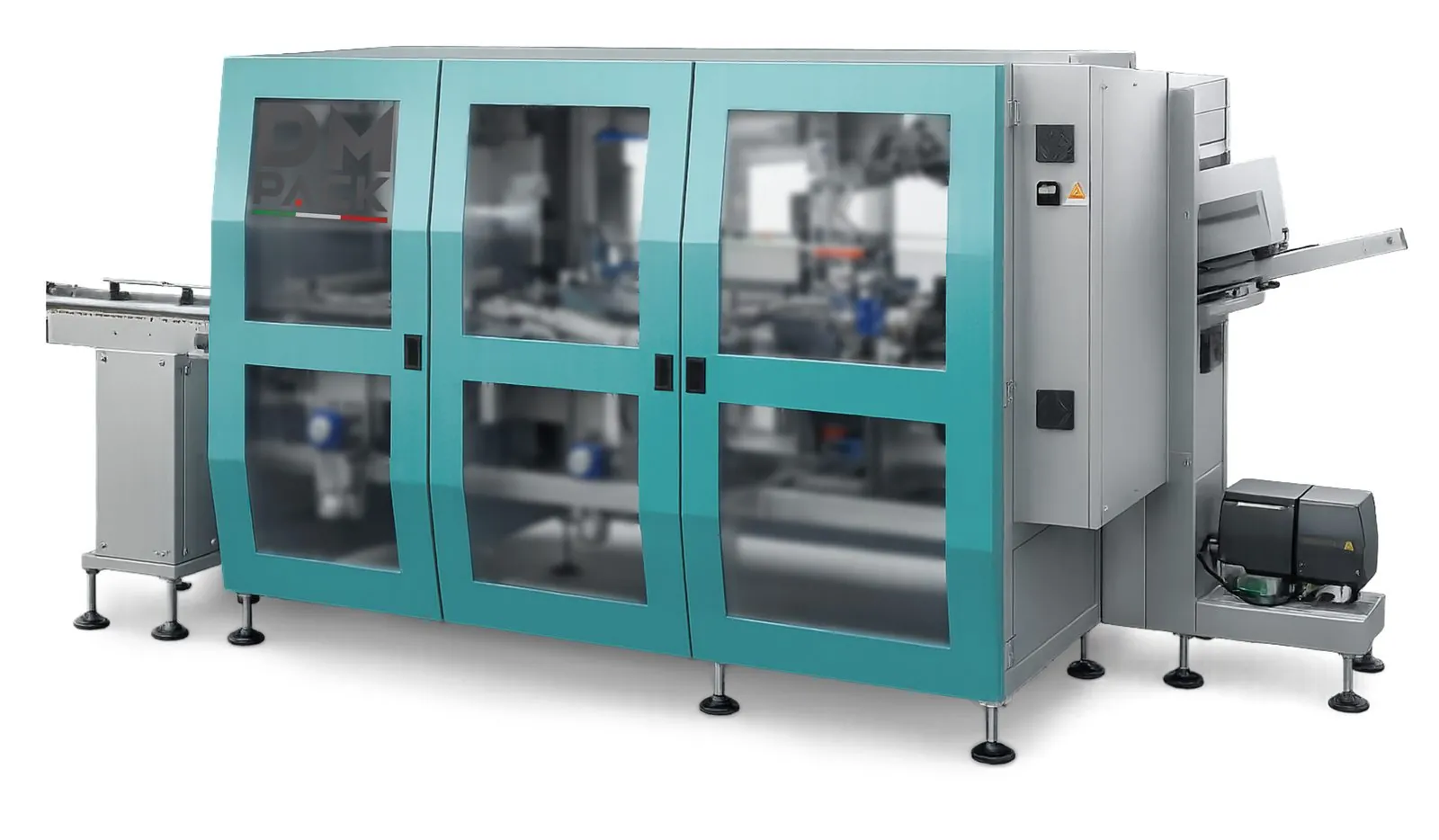
DM PACK DRON — high-resolution manufacturer photograph.
The DM PACK DRON is a horizontal secondary packaging machine for corrugated board. It picks a flat blank from its magazine, forms it, inserts the products — single or in multipacks — then seals the flaps with hot-melt glue. What sets it apart from most case packers on the market can be summed up in one sentence: it handles the three main families of secondary cardboard packaging on a single platform, where three separate machines are often needed.
INVOLTEC distributes DM PACK machines in France and supports the project from start to finish: product and output analysis, costing, installation and commissioning, staff training and after-sales service.
One platform, three applications
The choice between these three formats depends on the product, the distribution channel and the shelf. Switching from one to another on a DRON is a format changeover, not a change of machine.
Wrap-Around
The cardboard blank is folded around the group of products and then glued. The result: a case that fits the product snugly and uses less cardboard than a regular slotted case that is erected and then filled.
Typically: multipacks of cans, bottles, boxes, jars.
Tray (open tray)
A low tray is formed and filled from above. Depending on the blank, the result is a shipping tray or a shelf-ready tray display, with no extra handling in store.
Typically: biscuits, grocery, pet food, cleaning products.
Tray & Lid — tray with lid
A tray and its lid, glued on the inside or outside depending on the desired presentation, for complete protection of the contents without using plastic film.
Typically: fragile products, long-distance shipping, e-commerce.
How the DRON works
The cycle breaks down into four stages:
- Picking — the flat cardboard blank is extracted from the magazine, which the operator keeps continuously supplied.
- Forming — the blank is folded over a mandrel in the chosen configuration (wrap-around, tray or base-and-lid).
- Filling — the products, single or grouped in multipacks, are inserted into the case as it is formed.
- Sealing — the flaps are hot-glued and held while the glue sets, giving a stable case and consistent closure from one batch to the next.
The machine can be configured as an intermittent version — the case stops at each station, for moderate volumes and a smaller footprint — or as a continuous version, where the flow never stops, for high output. The choice depends on the target output and the space available at the end of the line, and it must be made at the design stage: it is not an option that can be added afterwards.
The DRON in operation — video clip © DM PACK.
Technical specifications
| Specification | Value |
|---|---|
| Applications | Wrap-around · tray · tray display · base-and-lid (tray & lid) |
| Configuration | Intermittent or continuous version |
| Closing system | Hot-melt glue on the flaps |
| Products | Single products or multipacks |
| Output | Intermittent version: up to 12 cases/min. Continuous version: up to 35 cases/min single-lane, up to 50 cases/min dual-lane |
| Case format range | From 50 × 150 × 100 mm to 400 × 600 × 400 mm (L×W×H) — up to 1,000 × 1,200 mm on request |
| Accepted board | Single- or double-wall corrugated board — B and EB flutes are the most common, minimum thickness around 3 mm. C flute possible for heavy products. Kraftliner or recycled testliner, to FEFCO / GIFCO standards |
| Power supply | 400 V 3PH+N+E — 4 kW for the loader, 17 kW for the wrap station |
| Compressed air | Constant 6 bar; flow rate depending on configuration |
| Working height | Approx. 600 mm, depending on the layout |
| Weight | 1,800 kg |
| Standard colours | RAL 9007 + RAL 5018 |
| Overall footprint | Depends on the configuration. For example, a DRON line with loader and blank magazine occupies approx. 5.2 × 4.3 m of floor space and is 2.37 m high |
| Format changeover time | Approx. 20 minutes, depending on the configuration |
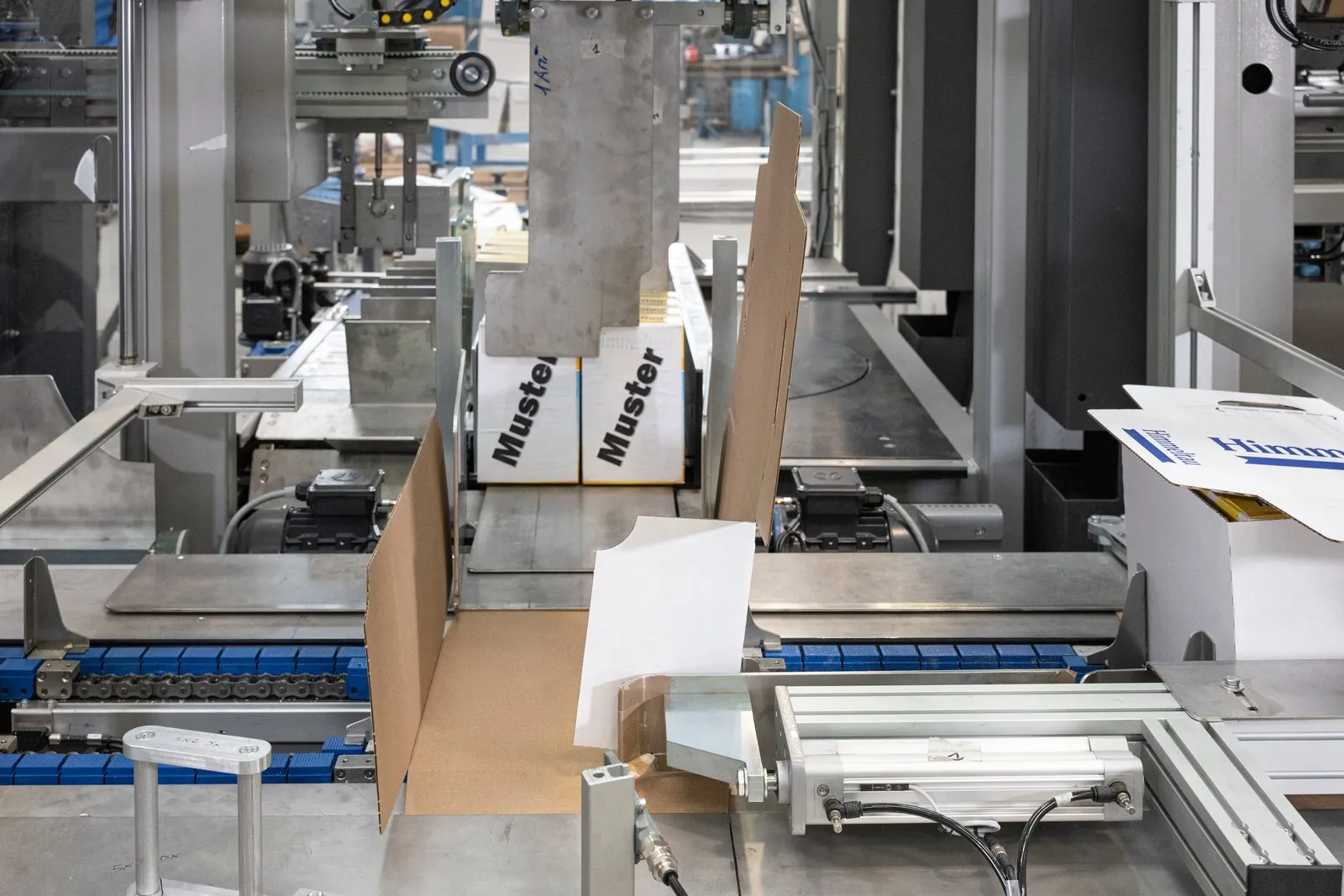
Insertion station: the product is inserted into the formed blank.
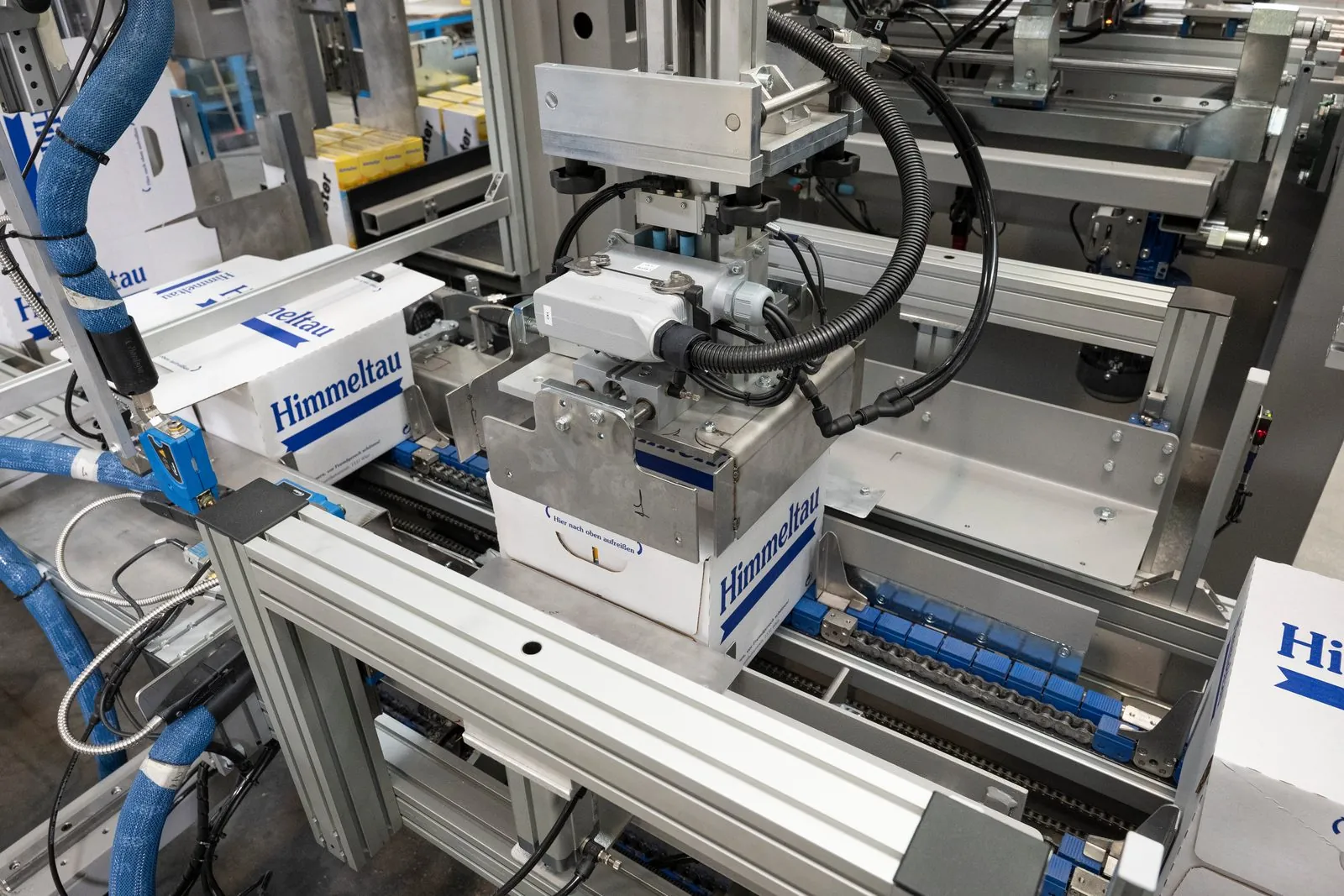
Closing station: flaps sealed with hot-melt glue on a wrap-around case.
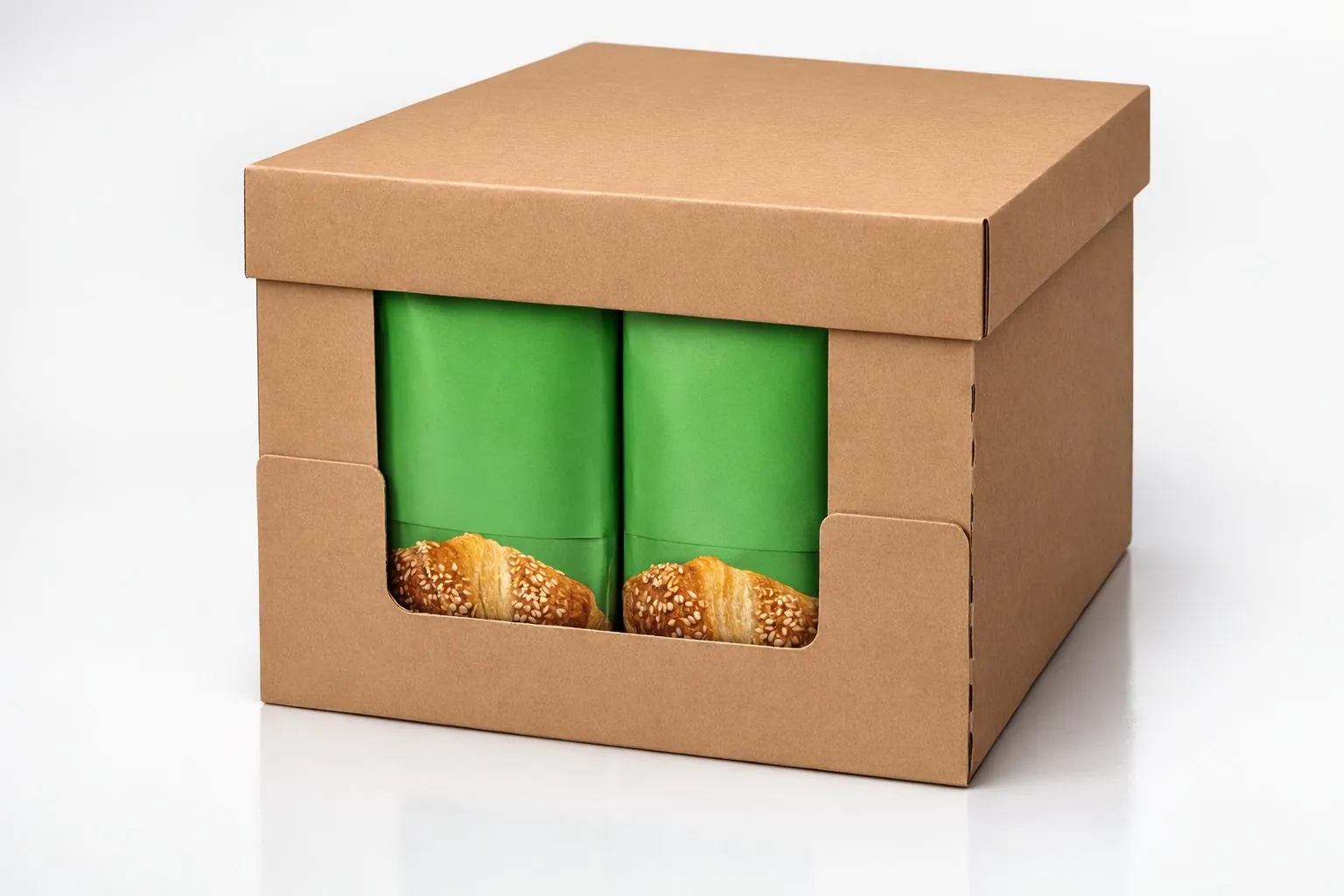
Finished base-and-lid pack: windowed tray, lid fitted, flow-wrapped products inside.
Manufacturer data. The overall footprint and compressed air consumption are confirmed during the study of your project; for an accurate quote for your product, tell us what you need.
Which cardboard for the DRON
It is one of the very first questions asked during the study, and the answer is more open than you might think. The DRON handles single- or double-wall corrugated board. The most common configurations are B and EB flutes, with a minimum thickness of around 3 mm. The thicker C flute suits heavy products and applications where mechanical strength matters more than the appearance of the case.
As for the material, the machine does not require any particular grade: both kraftliner and recycled testliner are suitable, provided the board meets the usual corrugated industry standards — the FEFCO and GIFCO codes — and the mechanical properties required by the application. The exact composition is determined project by project, with the customer’s board supplier, according to the product and the palletising method chosen at the end of the line.
One point reassures companies wary of depending on a single supplier: you keep your board supplier. Once the order is confirmed, DM PACK supplies the DWG drawings of the blanks and the mechanical specifications needed to optimise performance. Any qualified corrugated board manufacturer can then produce packaging that meets the project requirements. When converting from polyethylene film to a wrap-around or base-and-lid solution, the manufacturer can also recommend board suppliers it knows, if the customer so requests.
Which products and sectors
The DRON is designed for manufacturers who ship grouped products and want to secure the pallet while keeping their packaging consumption under control:
- Food and biscuit manufacturing — trays and tray displays for retail chains, where secondary packaging also serves as a sales medium.
- Beverages and canned goods — wrap-around multipacks, the original format of this technology.
- Pet food — heavy products, tall pallets: case strength is the deciding criterion.
- Cleaning products and chemicals — trays and base-and-lid packs for containers that do not withstand crushing well.
- Cosmetics and perfumery — downstream of an overwrapping line, for grouping and shipping.
Some DRON installations in Europe
Extracts from the reference list provided by DM PACK. Customers are not named; output figures are those stated by the manufacturer for each installation.
| Sector and product | Country | Configuration | Year |
|---|---|---|---|
| Milling — bags of flour | Germany | DRON wrap-around — 30 to 34 pieces/min | 2024 |
| Cereals — boxes of rice and cereal flakes | Germany | DRON trays and wrap-around — 6 to 8 cases/min | 2020 |
| Food — boxes of flour | United Kingdom | DRON trays, intermittent version | 2018 |
| Milling — bags of flour | Albania | DRON wrap-around + TRON ROBOT palletiser — 6 cases/min | 2025 |
| Pet food — food pouches | Italy | Two lines: DRON wrap-around and DRON base-and-lid, each with a TRON AXIS palletiser | 2025 |
| Ready meals | Italy | ICE + DRON tray and lid + Cartesian palletiser | 2020 |
| Dairy products — pots | Italy | ICE + DRON wrap-around | 2020 |
| Household goods — freezer bags | Italy | SKY + DRON base-and-lid + TRON COMPATTO | 2020 |
Cardboard or film: how to choose
The question comes up in almost every secondary packaging project, and it has become more pressing since the European packaging regulation started to apply. There is no single answer: INVOLTEC distributes shrink bundlers and shrink tunnels as well as cardboard machines, and the right choice depends on the product, not on a preference in principle.
| Criterion | Shrink film | Cardboard (wrap-around / tray) |
|---|---|---|
| Material cost | Generally lower per pack | Higher, but offset when the cardboard pack replaces an outer case |
| Pallet stability | Little inherent rigidity, depends on the product | Structural rigidity, easier stacking |
| Shelf presentation | Little visual impact | Printable surface, shelf-ready tray display |
| Sorting and recycling | Plastics stream, variable sorting rate | Paper and board stream, well established |
| Consumable storage space | Compact reels | Flat blanks, bulkier storage |
| Energy | Shrink tunnel to be heated | Hot-melt glue, more targeted consumption |
In practice, switching from film to cardboard is justified when the case must stand on its own on the pallet, serve as a sales medium, or when the company’s packaging strategy aims to reduce its share of plastic. It is not justified if the product is irregular or very light, or if the material saving of film remains decisive. The subject is covered in more detail in practical guides no. 14 and no. 17.
Integrating the DRON into a complete line
A case packer never works in isolation: it sits between an upstream section that groups the products and a downstream section that builds the pallet. DM PACK designs complete lines, which avoids interface problems between equipment from different brands.
Upstream
Product grouping and infeed, conveying, presence check, integration of a loading robot depending on the product.
Downstream — lids
The LIDON forms and fits made-to-measure lids when the application requires it.
At the end of the line
The TRON range covers palletising, from the compact Cartesian unit to the anthropomorphic robot in a complete cell.
What INVOLTEC brings
A study before a price
Product, output, case format, available space: the costing comes after the analysis, not before. That is what prevents an oversized machine or an unsustainable output target.
Installation and commissioning
Connection, adjustments, production trials with your actual products and blanks, through to output validation.
Qualiopi-certified training
Operation, format changeover and first-level maintenance, in sessions of no more than 3 trainees to focus on hands-on practice.
Frequently asked questions
Further reading
Content based on DM PACK documentation (2026 general catalogue, DRON brochure) and discussions with the manufacturer. Photographs and video © DM PACK, used with permission.