
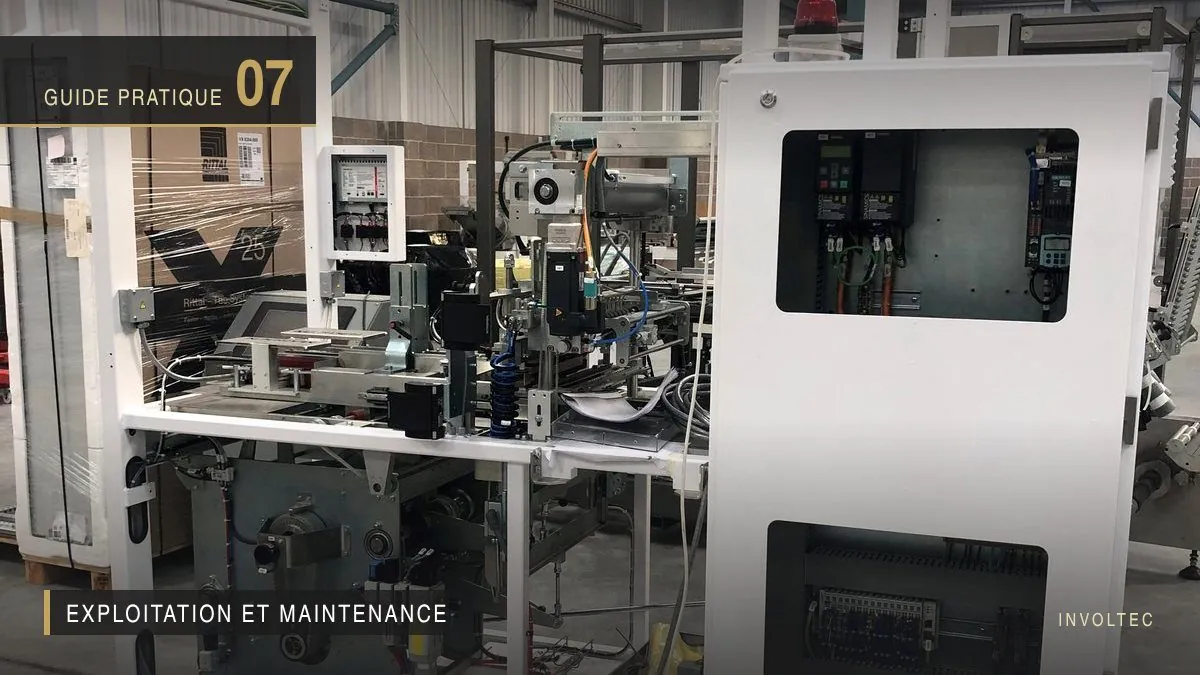
Why one hour of planned maintenance is better than four hours of unplanned downtime.
Maintenance is not about repairing a machine
In many companies, maintenance is still seen as a corrective activity: you step in when a breakdown occurs.
This approach is costly.
Every unplanned stoppage leads to lost production, disrupts teams, causes delivery delays and puts more pressure on operators and technicians alike.
Conversely, well-organised preventive maintenance makes it possible to anticipate failures before they disrupt production.
Its aim is not only to prevent breakdowns. It is to sustain the machine’s performance over time and guarantee consistent quality.
Read the rest of the guide
Enter your business contact details: you get immediate access to the whole of this guide and all INVOLTEC guides, on this device.
Coming up in the rest of the guide:
- One hour of planned maintenance is better than four hours of unplanned downtime
- The best indicator is not the number of breakdowns
- Maintainability is decided at the design stage
- The hidden cost of an intervention
- Maintenance tasks to plan for
- The parts you should always keep in stock
- … and 4 more sections
One hour of planned maintenance is better than four hours of unplanned downtime
An intervention carried out during a scheduled stop is under control.
The parts are available.
The technicians are prepared.
The tools are ready.
Production is organised around the intervention.
By contrast, an unplanned breakdown often ties up several people in a rush.
The real cost far exceeds the cost of the repair.
You need to take into account:
- the line stoppage;
- products waiting to be packed;
- idle operators;
- lost output;
- any rejects on restart.
Maintenance is therefore an investment in line availability.
The best indicator is not the number of breakdowns
Many companies track only:

- the number of interventions;
- the cost of parts.
These indicators are useful but not sufficient.
The most relevant indicators are:
- mean time between failures (MTBF);
- mean time to repair (MTTR);
- machine availability;
- OEE (overall equipment effectiveness);
- the cost of production downtime.
A machine that rarely breaks down but stops the line for several hours at each intervention can perform worse than a machine that needs more frequent but very quick interventions.
Maintainability is decided at the design stage
Good maintenance starts even before the machine is installed.
Accessibility of components is essential.
It must be possible to carry out every intervention quickly and safely.
When choosing an overwrapping machine, look in particular at:
- access to the sealing heaters;
- belt replacement;
- access to the sensors;
- visibility of the mechanical assemblies;
- the lubrication points;
- the areas to be cleaned.
A component that is hard to reach always costs more to replace.
Not because the part is more expensive.
But because production stays at a standstill for longer.
The hidden cost of an intervention
Let’s take an example.
A drive roller needs replacing.
The roller costs a few tens of euros.
On a well-designed machine:
- replacement in 10 minutes.
- On a less accessible machine:
- removal of several guards;
- removal of one or more machine assemblies;
- adjustments;
- trials.
- Total time:
From 20 to 120 minutes.
The price of the roller has not changed.
But many minutes of production have been lost.
Over several years, this cost far exceeds the cost of spare parts or the price difference with well-designed equipment.
Maintenance tasks to plan for
It is hard to generalise, given how much models and machine generations differ. Nevertheless, the following points can be noted:

Daily
At the start or end of a shift:
- Visual check (iron filings, dust build-up, rubbing marks, loose screws, etc.)
- Machine cleaning (pieces of material in the cams, deposits on heating elements, conveyor belt, etc.)
Indicative duration: 5 minutes.
Weekly
- Cleaning — Material unwind rollers, segmented roller, …
- Lubrication — Guide shafts of the side-sealing cylinders, cam track, ball joint, pusher linear guide,
- Dust removal — Linear guide, reel brake pad and brake, machine table
Monthly
- Cleaning — Reel brake caliper
- Check — Belt tension
- Adjustment — Main motor belt tension
Annual
- Replacement — Cam followers: pusher, control slats · Ball joints: right-hand thread, left-hand thread, control slat lever · Nylon: shells, wires · Tilting unit: block, rod damper, guide bushing · Moving knife springs: right, left · Heat shield
- Check — Cam lever bushing, …
The parts you should always keep in stock
A prolonged stoppage is often due to a lack of parts.
The stock of critical emergency parts is defined by the manufacturer (sealing heaters and probes, belts, sensors, rollers, cam followers, fuses, common pneumatic components, etc.)
This list must be tailored to each machine, based on the manufacturer’s recommendations and the user’s own experience.
Maintenance is also a matter for operators
Operators are the first to detect any drift.
A slight change in noise.
A less consistent seal.
An unusual vibration.
A setting that is harder to get right.
These weak signals often make it possible to step in before a breakdown.
Training operators to recognise these symptoms is one of the most effective ways to improve line availability.
The most common mistakes
- Across installations, certain practices come up again and again.
- Postponing an intervention because the machine is still running.
- Waiting for a breakdown before replacing a wear part.
- Neglecting to clean the guiding components.
- Not recording the intervention history.
- Using non-compliant parts.
- Making adjustments without a documented procedure.
- These habits gradually increase the risk of unplanned stoppages.
Checklist: is your maintenance plan effective?
Ask yourself the following questions:
- Are daily tasks documented?
- Are interventions planned rather than reactive?
- Are critical parts available in stock?
- Can operators spot the first signs of wear?
- Are intervention times measured?
- Are the causes of breakdowns analysed?
- Are settings standardised?
- Are maintenance records kept?
If several answers are no, your maintenance plan can probably be improved.
Conclusion
Maintenance of an overwrapping machine should not be seen as a cost but as a lever for industrial performance. A preventive approach, accessible components, trained operators and planned interventions make it possible to improve equipment availability over the long term and protect production quality.
By factoring maintenance in from the moment you choose the machine, you reduce operating costs, improve your OEE and secure your investment over the long term.