
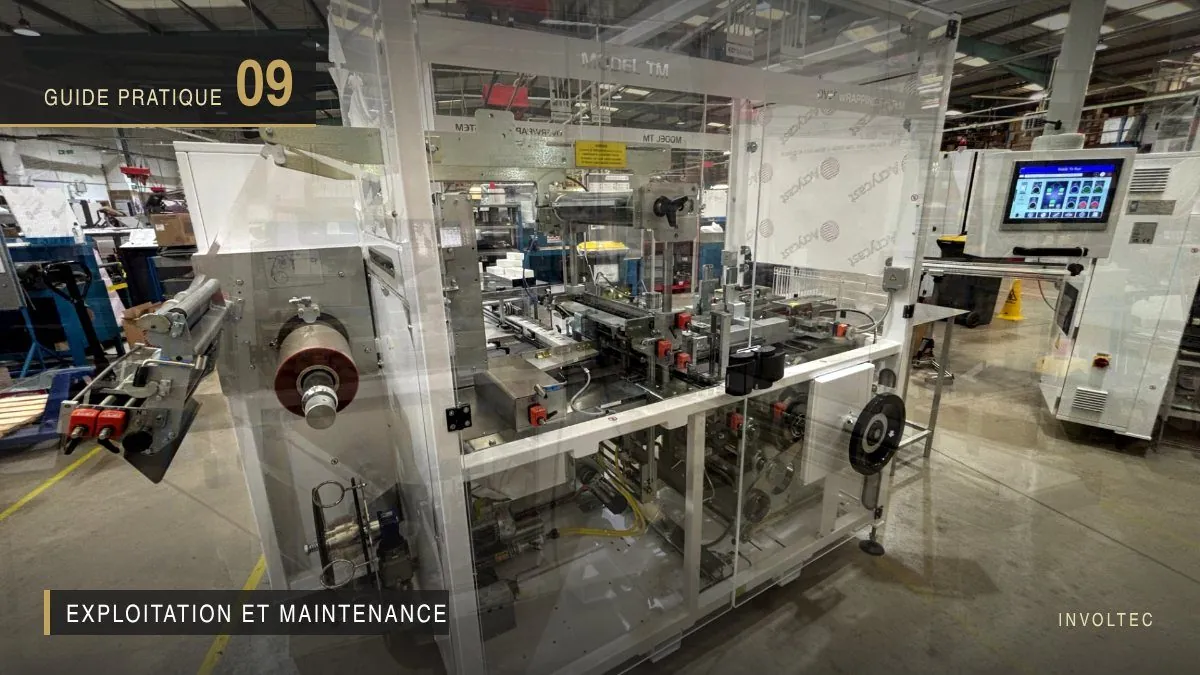
Preparation, FAT (factory acceptance test), SAT (site acceptance test), training, ramp-up: what determines the success of an industrial start-up.
Buying a machine is not enough
Acquiring a new overwrapping machine commits a company for seven to fifteen years.
Yet the success of a project does not depend solely on the quality of the machine.
Above all, it depends on the quality of the preparation.
A perfectly designed machine can become a difficult project if its installation is poorly planned.
Conversely, rigorous preparation generally makes it possible to cut start-up times significantly and secure the ramp-up of production.
Read the rest of the guide
Enter your business contact details: you get immediate access to the whole of this guide and all INVOLTEC guides, on this device.
Coming up in the rest of the guide:
- An industrial project starts several months before delivery
- Preparing the layout
- Planning consumables and trial products
- FAT: checking before shipment
- SAT: validating the machine in its real environment
- Ramp-up: an often underestimated stage
- … and 11 more sections
An industrial project starts several months before delivery
The most common mistake is to assume that the project starts when the machine arrives on site.
In reality, it starts as soon as the specification is approved.
Even before manufacture, several elements must be defined:
- the products to be run on the line;
- the products to be used for the FAT tests
- the expected output;
- the interfaces with existing equipment;
- the utilities available;
- layout constraints;
- performance targets;
- the responsibilities of each party.
- Training on the new equipment
The specifications we receive set out these elements well in advance, detailing the layout, upstream and downstream interfaces, available utilities, and the schedule for delivery, installation, commissioning, FAT, SAT and training.
Preparing the layout
A machine never works on its own.

It is part of a line.
Before delivery, you should check in particular:
- the space available;
- access for unloading;
- floor load capacity;
- electrical supplies;
- compressed air;
- IT networks;
- upstream and downstream conveyors;
- safety conditions.
- Wi-Fi access for maintenance
A well-prepared layout avoids costly modifications during installation.
Planning consumables and trial products
A machine installed without consumables does not produce. It is obvious, and yet one of the most frequent causes of delay at start-up.
While the machine is being built, two orders must be placed:
- the packaging material, in the web width and grade selected for the launch formats;
- the change parts for the SKUs that will be run from start-up.
You also need to plan a sufficient quantity of product for trials.
FAT and then SAT settings are carried out with the real product and the real material, not with a standard sample. Ramp-up trials consume more product than is generally anticipated.
This quantity must be agreed with production several weeks in advance, taking trial rejects into account.
FAT: checking before shipment
The factory acceptance test (FAT) is carried out at the manufacturer’s premises before the machine is shipped.

It checks that the equipment meets the specification before it is transported.
A well-prepared FAT greatly reduces the risks during commissioning.
The main points to check are:
General operation
- start-up;
- shutdown;
- safety devices;
- alarms.
Performance
- output;
- seal quality;
- accuracy of settings.
Ergonomics
- access to settings;
- format changeover;
- visibility.
- Understanding of the HMI (human–machine interface)
Documentation
- manuals;
- bills of materials;
- electrical drawings;
- program back-ups.
- Maintenance plan
The FAT must not be a mere sales demonstration.
It is an essential contractual stage.
SAT: validating the machine in its real environment
Once installed, the machine must be tested under the customer’s production conditions.
That is the purpose of the site acceptance test (SAT).
This phase makes it possible to check, in particular:
- integration with upstream and downstream equipment;
- communication with other equipment;
- real performance;
- the quality of finished products;
- operator behaviour.
A machine that works perfectly at the manufacturer’s premises may behave differently once integrated into a complete line.
Ramp-up: an often underestimated stage
The first day of production does not run at nominal output.
Ramp-up is gradual.
It makes it possible to fine-tune settings;
- train the teams;
- stabilise parameters;
- check performance.
Trying to reach maximum output straight away is rarely a good strategy.
Controlled progress safeguards quality and reduces the risk of drift.
Train the operators... and maintenance too
Training should not be limited to users.

The maintenance department must also be involved.
Technicians must know:
- settings;
- safety procedures;
- wear parts;
- maintenance plans;
- first-level diagnostics.
This training considerably reduces future downtime.
Training that can be funded
Training is a cost item that many companies add to the project budget too late.
INVOLTEC training courses are Qualiopi-certified (certificate no. CAP0869). They can therefore be included in French vocational training funding schemes, in the same way as the company’s other skills development initiatives.
This point is worth raising with the human resources department as soon as the order is confirmed, not at commissioning: the time needed to put together a funding application is rarely compatible with the urgency of a start-up.
Documents to obtain before final acceptance
Before signing off the acceptance, check that you have, in particular:
- electrical drawings;
- pneumatic drawings;
- PLC back-ups;
- HMI programs;
- bills of materials;
- the spare parts list;
- the maintenance plan;
- operator manuals;
- regulatory certificates.
These documents will be essential throughout the life of the machine.
The most common mistakes
- Across projects, certain situations come up again and again.
Underestimating preparation time
A machine installed in a rush often creates avoidable difficulties.
Training only the operators
The maintenance team sometimes first sees the machine several weeks after start-up.
Wanting to produce at maximum output immediately
Settings always require an optimisation phase.
Deferring the punch-list items
A comment made during the FAT is much easier to deal with than several months after acceptance.
Checklist before going into production
Before authorising the start of production, make sure that:
- The FAT tests have been approved and any reservations cleared.
- The SAT tests have been completed.
- The safety devices have been checked.
- The interfaces with neighbouring equipment are working.
- The operators have been trained.
- The maintenance department has been trained.
- Critical spare parts in stock
- The production format recipes have been saved.
- The technical documents are available.
- The expected performance has been checked and validated.
Indicators to monitor after start-up
The first few weeks are decisive. We recommend monitoring:
- daily OEE (overall equipment effectiveness);
- average format changeover time;
- the number of unplanned stoppages;
- the number of rejects at start-up;
- average maintenance intervention time;
- machine availability rate;
- the number of operator assistance requests.
These indicators make it possible to identify areas for improvement quickly and to consolidate the line’s performance.
Conclusion
Installing an overwrapping machine does not mark the end of a project, but the start of its most important phase: operation.
Rigorous preparation, structured testing, a gradual ramp-up and thorough training of the teams are the best guarantees of a successful start-up.
Beyond the machine’s performance, it is the quality of this approach that determines the long-term productivity, availability and return on investment of your packaging line.