
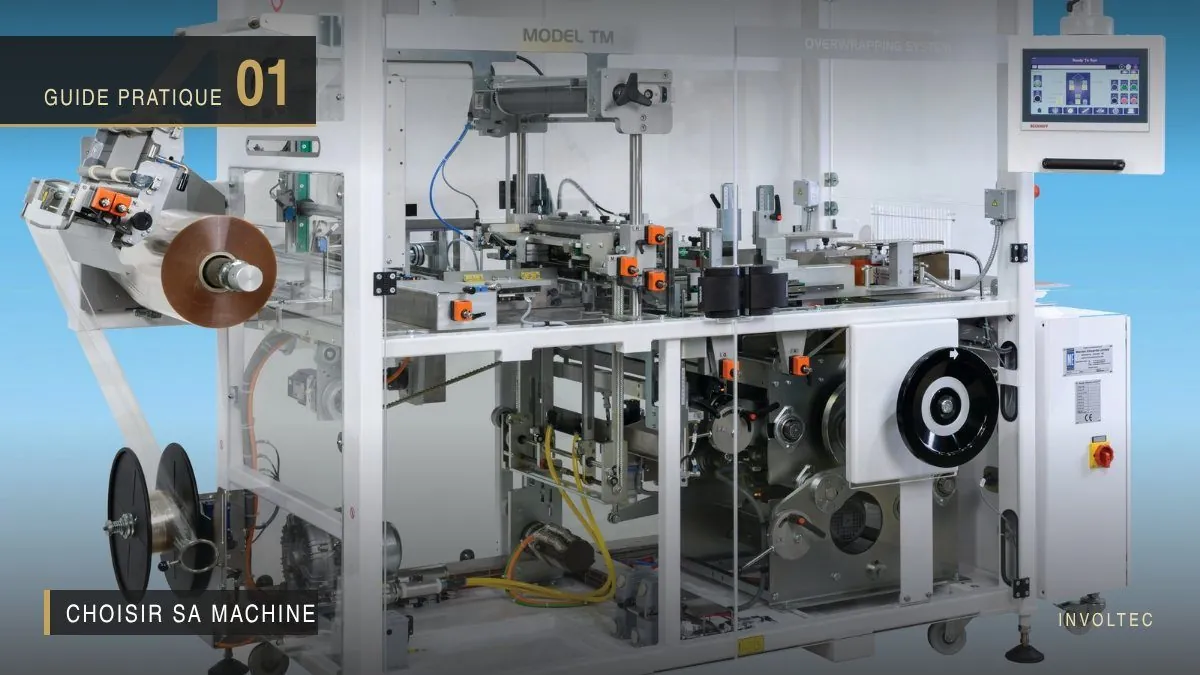
Why two overwrapping machines claiming the same output can perform very differently after five years of operation.
When a manufacturer consults several overwrapping machine suppliers, discussions often focus on three criteria: output, price and the product dimensions the machine can accept.
This information matters, but it does not allow you to assess the true performance of a piece of equipment.
Two overwrapping machines capable of running at 60 products/min can, after a few years of operation, show considerable differences in availability, maintenance costs and productivity.
Why?
Because theoretical output is only a small part of the real performance of a packaging line.
What really makes the difference are criteria often missing from sales brochures: ergonomics, maintainability, the simplicity of the HMI (human–machine interface), ease of format changeovers, component accessibility and the manufacturer’s responsiveness when needed.
We see this in the specifications we receive from cosmetics and perfume manufacturers: they place as much emphasis on ergonomics, maintenance, FAT (factory acceptance test)/SAT (site acceptance test) or documentation as on output itself.
The specification: the first key to a successful project
One of the most common mistakes is to choose an overwrapping machine solely on its output or price. In industrial reality, the starting point is always the specification.
In cosmetics, perfume and pharmaceuticals, the requirements go far beyond simply wrapping a product. The machine must meet very precise constraints defined by the end customer, the quality department, marketing and production.
The specification may, for example, require:
- no scratches whatsoever on cartons or gift boxes;
- perfectly taut material, with no creases, dog-ears or bubbles;
- discreet, perfectly regular seals;
- precise product orientation;
- tooling elements compatible with several formats;
- a guaranteed minimum output;
- limited format changeover times;
- high line flexibility.
The success of a project therefore depends on the manufacturer’s ability to analyse these constraints before even proposing a machine.
At INVOLTEC, we believe that a machine should never be chosen from a catalogue, but designed around the customer’s real needs.
This conviction explains the rest of this guide: all the criteria that follow — ergonomics, maintainability, interface, accessibility — appear in the specifications we receive, alongside output and often ahead of it.
Read the rest of the guide
Enter your business contact details: you get immediate access to the whole of this guide and all INVOLTEC guides, on this device.
Coming up in the rest of the guide:
- Output alone does not produce
- The true measure of performance: OEE (overall equipment effectiveness)
- The hidden cost: accessibility
- Inspect a machine with a maintenance technician
- Ergonomics is not about comfort
- An HMI designed for operators
- … and 3 more sections
Output alone does not produce
Imagine two machines.

Both claim:
- 60 products/min
- format changeover in 15 minutes
- spare parts availability
- identical power
On paper, they look equivalent.
Yet five years later:
Machine A still produces 60 products/min.
Machine B struggles to exceed 47 products/min.
The problem is not mechanical speed.
The problem is everything that happens around it.
The true measure of performance: OEE (overall equipment effectiveness)
A packaging line is not judged on its maximum speed.

It is judged on its OEE (overall equipment effectiveness), which combines three indicators:
- Availability: is the machine actually in a condition to produce?
- Performance: does it reach the planned output?
- Quality: are the products right first time?
A machine that stops often, needs frequent adjustments or creates packaging defects will see its OEE fall, even if its theoretical output is high.
There is also a factor that brochures rarely mention: the quality of tooling and change parts over time. Tooling that retains its precision causes few jams — even fewer when protected by a torque limiter — and preserves the appearance of the carton.
The hidden cost: accessibility
Let’s take a concrete example.

A belt needs replacing.
Machine A
open a cover
replace
restart
Time: 12 minutes
Machine B
remove two guards
remove a servo motor
difficult access
reassemble
adjustments
Time: 1 h 15 min
The belt costs the same.
The production stoppage, however, costs much more.
During that extra hour of downtime:
- production is stopped;
- operators are waiting;
- upstream products may build up;
- lead times lengthen.
Good design is about reducing this downtime.
Inspect a machine with a maintenance technician
During a project, many companies involve:
- purchasing;
- production;
- quality.
Less often, they involve the maintenance department.
Yet it is the maintenance technician who will immediately spot the future weak points:
- hard-to-reach components;
- hidden sensors;
- poorly visible adjustment devices;
- complicated lubrication;
- tedious cleaning.
These details directly affect operating costs throughout the machine’s life.
Ergonomics is not about comfort
The word ergonomics often suggests operator comfort.
In reality, it is a genuine performance lever.
An ergonomic machine is one where the operator:
- can see what is happening;
- can easily reach the settings;
- can quickly identify a fault;
- can intervene without complex dismantling.
The specifications we receive systematically ask for improvements in safety, ergonomics, maintenance and functionality, as well as tool-free change parts and accessible adjustment points.
Good ergonomics reduces:
- handling errors;
- downtime;
- fatigue;
- the risk of damage to products and packaging.
An HMI designed for operators
Industry faces a constant turnover of staff.
Temporary staff, new hires, internal transfers: operators do not always have several years’ experience on a machine.
An effective human–machine interface must therefore:
- use clear language;
- guide format changeovers;
- display understandable diagnostic messages;
- limit the risk of error;
- reduce training time.
A complex HMI can hold back productivity, even if the machine’s mechanics are sound.
Scratches: an often underestimated defect
In cosmetics and perfume, a perfectly functional product can be rejected for a mere scratch on the carton or on the material.
The type of conveyor belts, guides and accumulation zones plays a key role.
The specifications we receive even require equipment to stop in the event of accumulation, to avoid any risk of scratching, as well as conveyor transfers designed not to damage cartons.
The quality of overwrapping therefore does not depend solely on the folding module: it starts as soon as the product is picked up.
10 questions to ask before you invest
Before choosing an overwrapping machine, ask the manufacturer:
- How long does a routine maintenance intervention actually take?
- Which components are accessible without major dismantling?
- Can the tooling be fitted without tools?
- How long does it take to train a new operator?
- Does the HMI guide format changeovers?
- Are the change parts light and easy to handle?
- How does the machine protect cartons against scratches?
- What are the daily cleaning points?
- What performance indicators are available on the HMI?
- What support is planned after commissioning?
Conclusion
An overwrapping machine is an investment that will support your production for many years. Its value is not measured solely by its maximum output, but by its ability to keep performing day in, day out.
Choosing a machine that is simple to use, easy to maintain, designed to protect products and built around the real constraints of your teams is often the best way to improve your productivity in the long term… and your OEE.
Further reading
- Guide no. 5 — How to choose your overwrapping machine: a four-question method
- Guide no. 7 — Preventive maintenance of an overwrapping machine: improving your OEE for the long term
- Guide no. 8 — Overwrapping machine format changeover: reducing downtime without sacrificing quality
- See MARDEN EDWARDS overwrapping machines