
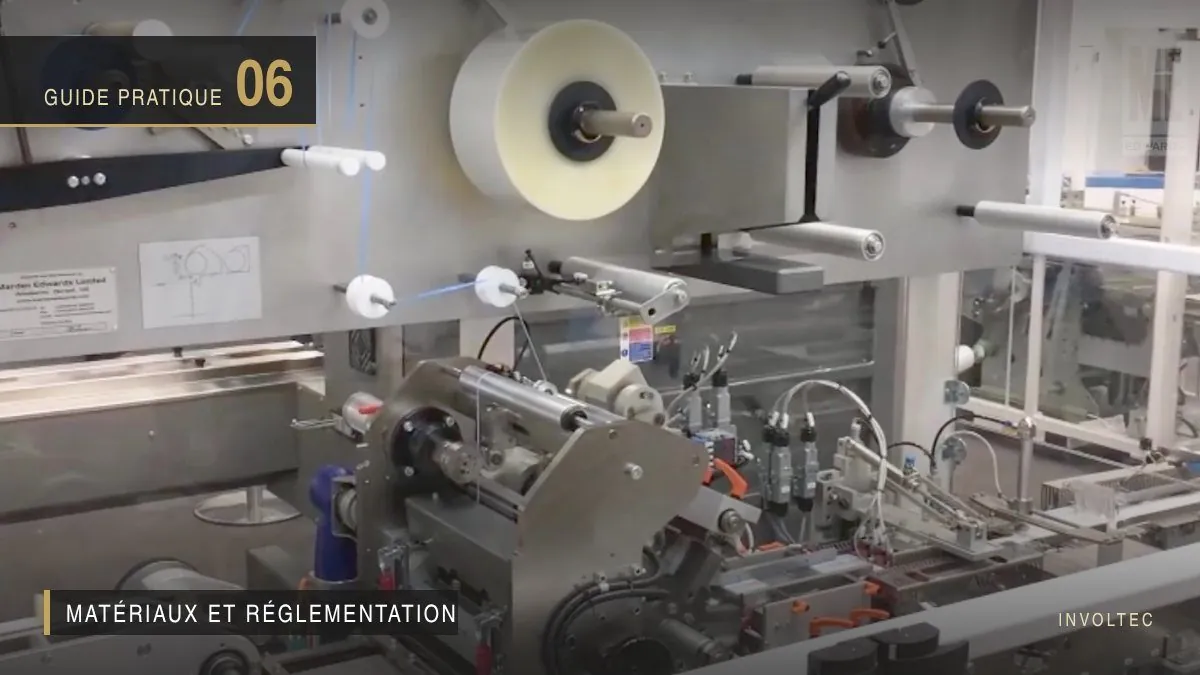
How to choose the right material to ensure the quality, productivity and cost-efficiency of your packaging.
Packaging material: the cheapest component… but often the most decisive
When preparing an overwrapping project, attention naturally focuses on the machine.
Yet the packaging material used — polypropylene film, BOPP, cellulose film, heat-sealable paper or 100% paper packaging — has a direct impact on:
- seal quality;
- the final appearance of the product;
- the maximum usable output;
- setting times;
- the frequency of production stoppages;
- the overall operating cost.
In other words, an excellent machine running an unsuitable material will never deliver the expected performance.
Conversely, choosing a material perfectly suited to the product and the machine can often significantly improve packaging quality without modifying the equipment.
The choice of material is therefore a genuine industrial decision that must be built in from the moment the specification is drafted.
Read the rest of the guide
Enter your business contact details: you get immediate access to the whole of this guide and all INVOLTEC guides, on this device.
Coming up in the rest of the guide:
- The material does more than just wrap the product
- There is no universal material
- Three parameters to define before discussing aesthetics
- Polypropylene (PP)
- BOPP (biaxially oriented polypropylene)
- Cellulose films
- … and 10 more sections
The material does more than just wrap the product
Packaging material performs several functions at once.
It protects the product from external damage.
It guarantees that the pack is tamper-evident.
It enhances the product by improving its presentation.
It sometimes makes logistics operations easier.
Finally, it contributes directly to the brand’s environmental image.
Depending on the industry, these objectives do not carry the same weight.
In perfume and luxury goods, visual excellence is often the priority.
In pharmaceuticals, safety, regulatory compliance and traceability come first.
In food, mechanical performance, hygiene requirements and reducing plastic packaging are becoming essential criteria.
There is no universal material
This is probably the first lesson of this guide.
There is no material that can perfectly meet the needs of every application.
Each solution has:
- its advantages;
- its limitations;
- its processing constraints;
- its setting requirements.
The best choice is always the one that meets the product’s real needs and the project’s industrial objectives.
Three parameters to define before discussing aesthetics
Even before comparing families of materials, three technical parameters must be decided. They depend directly on the machine and the product.
Web width.
This is the width of the reel. It is calculated from the product dimensions and the type of fold.
An oversized web width creates waste on every product wrapped; one that is too narrow causes overlap defects and creases.
Grammage and thickness.
If it is too thin, the material tears and copes poorly with acceleration.
If it is too thick, it seals less well, folds less cleanly and limits output.
Sealing behaviour.
Each material has its own temperature window, which must be matched to the machine’s sealing units.
These three parameters explain why a material is never chosen independently of the equipment.
At INVOLTEC, we determine the theoretical web widths for each product before any production trial.
Polypropylene (PP)
Polypropylene remains the most widely used material on overwrapping lines today.
Its main advantages are:
- excellent transparency;
- controlled cost;
- good mechanical strength;
- wide availability;
- high production speeds.
On the other hand, it requires good control of sealing temperatures, and some grades can be more sensitive to setting variations.
It is an excellent solution for high-volume production.
BOPP (biaxially oriented polypropylene)
BOPP is now widely used in cosmetics, luxury goods and food.
Its success rests on several qualities:
- excellent gloss;
- very high transparency;
- good stiffness;
- excellent printability.
It produces particularly attractive packaging while remaining compatible with high production speeds.
Cellulose films
Cellulose-based films are increasingly attractive to companies committed to reducing their environmental impact.
Their main benefit lies in their bio-based origin and, depending on the grade, their suitability for industrial composting.
They also offer an aesthetic finish valued in luxury goods, natural cosmetics and premium products.
On the other hand, they are generally more demanding to run.
They require more precise setting of sealing temperatures, film tension and machine parameters.
Switching from polypropylene film to cellulose film is therefore not simply a matter of changing a reel. It requires proper industrial validation.
Glassine paper
Glassine paper is an intermediate alternative, valued for its distinctive finish, both translucent and slightly satin.
It is often chosen for its more natural positioning, particularly for natural cosmetics, artisan products and traditional confectionery.
Its mechanical behaviour, however, calls for particular attention to tension settings and control of workshop humidity.
Heat-sealable papers
Heat-sealable papers are currently undergoing significant growth.
They retain a high-quality paper look while remaining compatible with a conventional heat-sealing process.
They fully meet the expectations of companies wishing to reduce the visible presence of plastic in their packaging.
On the other hand: sealing temperatures differ from those of plastic films;
- maximum speeds may be more limited;
- their mechanical behaviour is generally less forgiving.
The choice of machine and the quality of the settings then become decisive.
Printed material
When the material is printed, defining the heat-sealable areas becomes an issue in its own right.
The seal must fall on an area designed for it; otherwise appearance or seal-strength defects occur.
This constraint means that the print artwork and the fold layout must be worked on together, before the reels are ordered.
This is something we systematically address with the customer and their printer before launching a first production run.
100% paper packaging with heat-activated adhesive
The drive to reduce plastic packaging is now leading to the development of new solutions using 100% paper packaging.
In response to this trend, some overwrapping machine manufacturers have developed technologies that apply a heat-reactivated adhesive with great precision, only to the areas that are to be joined.
As the pack passes through the machine’s closing section, this adhesive is reactivated by heat and ensures a reliable closure.
Unlike heat-sealable papers, this technology keeps the packaging made entirely of paper while limiting the amount of adhesive to the functional areas only.
Depending on the adhesives used and the packaging design, it is also possible to preserve the material’s environmental properties, notably its recyclability.
These solutions are particularly popular in the food industry, where requirements for plastic reduction are becoming increasingly stringent.
Like any new technology, however, they require complete control of the process: spray accuracy, adhesive dosing, reactivation temperature, contact time and synchronisation with the production speed.
The choice of machine plays a decisive role here in guaranteeing consistent closure quality.
Recyclable films
New regulations and CSR commitments are accelerating the development of recyclable films.
However, the choice should not be driven solely by their environmental impact.
It is also important to assess:
- how they behave on the machine;
- their stability;
- seal quality;
- their availability;
- their overall cost in use.
A sustainable solution must also perform well industrially.
A material directly affects output
Each material has its own characteristics:

- stiffness;
- coefficient of friction;
- mechanical strength;
- shape memory;
- sealing temperature.
- These parameters directly affect:
- the maximum achievable speed;
- the machine’s accelerations;
- fold quality;
- seal stability.
Increasing output may therefore require a change of material.
Conversely, adopting a new material may mean revising output targets.
Seals: a delicate balance
A good-quality seal always results from a balance between:
- temperature;
- contact time;
- pressure;
- the material’s own characteristics.
Raising the temperature does not automatically improve the seal.
Conversely, excessive temperature can cause:
- distortion;
- unwanted shiny patches;
- a burnt appearance;
- sticking to the tooling.
Fine-tuning a line is precisely about finding the best compromise between quality, output and stability.
The most common mistakes
The same mistakes come up again and again in packaging projects.
- Choosing a material on price alone A few cents saved on a reel can lead to several hours of production downtime.
- Changing supplier without production trials Two materials with similar specifications can behave very differently.
- Increasing output without adjusting the settings Any increase in speed changes temperatures, tensions and accelerations.
- Overlooking storage conditions
- Materials remain sensitive to: humidity; temperature; impacts; static electricity. Unsuitable storage can seriously impair how they behave on the machine.
12 questions to ask before choosing a material
- What product do you want to pack?
- What visual finish is expected?
- What actual output do you want to achieve?
- Is your machine compatible with this material?
- Are the sealing temperatures suitable?
- Does the material meet regulatory requirements?
- Do you want to prioritise a recyclable, bio-based or 100% paper material?
- What will be the overall cost of this change?
- Are operators trained in these new settings?
- Does the supplier guarantee consistent quality?
- Have trials been carried out on your product?
- Has performance been validated under conditions representative of your production?
Conclusion
Choosing a packaging material should never be seen as a simple purchasing decision.
Today, the available solutions go far beyond traditional plastic films and also include bio-based materials, heat-sealable papers, recyclable films and 100% paper packaging using innovative heat-reactivated adhesive technologies.
This diversity is a tremendous opportunity to reduce the environmental impact of packaging, provided the material is chosen according to the product, the expected performance and the actual capabilities of the machine.
At INVOLTEC, we consider the choice of material to be an integral part of a packaging line’s specification. A high-performing machine is not one that runs with a particular material, but one that consistently delivers the best result with the material best suited to each customer’s industrial, economic and environmental objectives.