
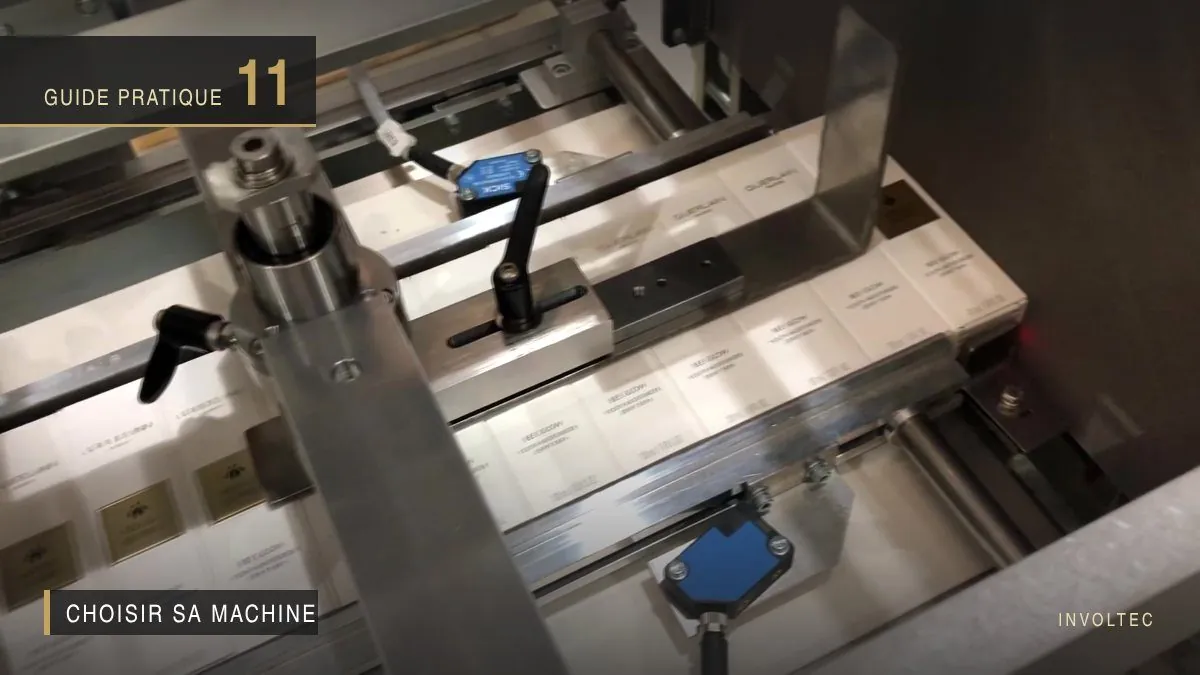
Versatile and cheaper to buy, adjustable consoles show their limits as soon as product appearance becomes a quality criterion.
How do adjustable consoles work?
The principle is to move various elements of the tooling that guides the material, so as to adapt the machine to products of different dimensions.

To allow these adjustments, the points of contact with the material are limited to their ends. The guides of the segments and tuckers can thus be moved apart or closer together in width and height without changing the entire tooling.
This design provides versatility, but it profoundly changes the way the material is guided.
Read the rest of the guide
Enter your business contact details: you get immediate access to the whole of this guide and all INVOLTEC guides, on this device.
Coming up in the rest of the guide:
- Less controlled material tension
- The limits become even more visible at high output
- Why the major luxury brands choose dedicated tooling
- A different design philosophy
- The choice must start from the specification, not just the price
- The most common mistakes
- … and 2 more sections
Less controlled material tension
With adjustable consoles, the material is no longer held continuously over its entire contact surface.
The result is less uniform tension, more sensitive to the settings made by the operator, to component wear, and to variations in product positioning and dimensions.
The result is overwrapping whose quality can vary over the course of production. Two successive format changeovers, carried out by two different operators, will not necessarily produce the same result.
This variability is often acceptable for everyday products, but it becomes a problem as soon as the packaging contributes to the product’s image.
The limits become even more visible at high output
The higher the production output, the more decisive control of the material path becomes.
At high speed, the material must be guided, held and tensioned perfectly consistently all along its path. Yet the very principle of adjustable consoles relies on limited points of contact, so that width and height can be adjusted.
This design cannot provide optimal support for the material over its entire surface. Tension variations then become more noticeable, which can lead to creases, dog ears, presentation defects or less consistent quality as output increases.
In practice, it is very difficult today to achieve a high and perfectly repeatable level of quality with adjustable consoles on high-output production. The higher the speed, the more visible the limits of this technology become.
Why the major luxury brands choose dedicated tooling
Brands in luxury goods, perfume, cosmetics and pharmaceuticals demand flawless, perfectly repeatable presentation quality.

In these environments, a slight defect in material tension, a less crisp fold or a slightly irregular seal can be enough to undermine how the product is perceived.
That is why these manufacturers overwhelmingly prefer tooling dedicated to each format. It holds the material along its entire path, ensuring perfectly uniform tension and an identical result from one production run to the next.
This repeatability is now a standard expected by the major luxury houses, which are generally not satisfied with the more variable quality obtained with adjustable consoles.
Money saved at the outset can cost more later
Doing without dedicated tooling does indeed reduce the initial investment.
However, this saving can quickly be offset by:
- longer setting times;
- greater dependence on operator know-how;
- more trials during format changeovers;
- less consistent quality;
- additional rejects;
- production rework;
- limited performance as output increases.
On recurring production, the overall operating cost often turns out less favourable than with a machine fitted with specific tooling.
A different design philosophy
It is also worth asking where this technical choice comes from.
Adjustable consoles are above all a response to machine standardisation. The same equipment can be offered for a large number of formats while limiting the number of specific tooling sets to be designed and manufactured.
Conversely, developing dedicated tooling requires more engineering, design and manufacturing work. It is an additional investment for the manufacturer, but above all a technical choice that serves the customer.
At INVOLTEC, we believe that an overwrapping machine should not be designed to be simpler or cheaper to build. It should be designed to meet its user’s specification: presentation quality, output, ergonomics, easy format changeovers, ease of maintenance, repeatability and overall operating cost.
This approach is particularly important when operators change regularly. A high-performing machine should not depend on the know-how of whoever does the setting; it should be able to reproduce the same level of quality day after day.
The choice must start from the specification, not just the price
The choice of an overwrapping machine should never be limited to the purchase price of the machine.
The real starting point is the specification: level of aesthetic requirement, output, repeatability, ease of use, ergonomics of the HMI (human–machine interface), format changeover time, accessibility of maintenance components, cost of interventions and total cost of ownership.
A machine that requires delicate settings, depends heavily on operator experience or needs lengthy maintenance work because components are hard to reach always ends up costing more than it seemed at the time of purchase.
For products where the packaging adds value to the brand, dedicated tooling is almost always the best solution. It guarantees consistent quality, independent of the operator, and ensures presentation that meets the standards of the most demanding sectors.
A machine should adapt to the product, not the product to the machine. That is why, whenever the specification requires it, we favour tooling specifically designed for each format rather than universal solutions that force a compromise on quality.
The most common mistakes
- Judging an adjustable console on a single trial A setting made by a manufacturer’s technician, on a chosen product and in good conditions, says nothing about the repeatability achieved six months later by three different operators.
- Comparing machine prices without comparing operating costs The saving made on tooling is paid back in setting time, touch-ups and rejects as soon as the number of formats and the quality requirements increase.
- Overlooking carton variability Adjustable guiding amplifies dimensional variations in the board. A console that suits a perfectly stable carton becomes unstable as soon as the supplier changes batch.
- Confusing versatility with flexibility Versatility means accepting many formats. Flexibility means switching from one to another quickly and getting the same result. It is not the same promise.
- Deciding before writing the specification The guiding method follows from the required level of quality and the structure of production runs, not the other way round.
Checklist: adjustable consoles or dedicated tooling?
- How many formats will the machine really have to handle, and how often?
- What share of production do these formats represent in volume?
- Is the appearance of the packaging a contractual quality criterion?
- Are your cartons dimensionally stable from one batch to the next?
- What real output must you sustain on your main SKUs?
- How many different operators will carry out format changeovers?
- Are settings stored and recalled by the HMI, or re-entered manually?
- What reject rate are you prepared to accept on restart?
- Has the cost of dedicated tooling been compared with the annual cost of settings and touch-ups?
- Has a mixed solution been considered (dedicated tooling on strategic SKUs)?
Conclusion
Adjustable consoles are not a bad technology: they are machines designed for a deliberate compromise, trading repeatability for versatility.
The right decision criterion is therefore not the number of formats on offer, but the level of consistency your market demands. Everyday production copes very well with slight variability; a perfume gift box, a medicine box or a premium skincare carton does not.
As always, the decision is made in the specification, before the price comparison.