
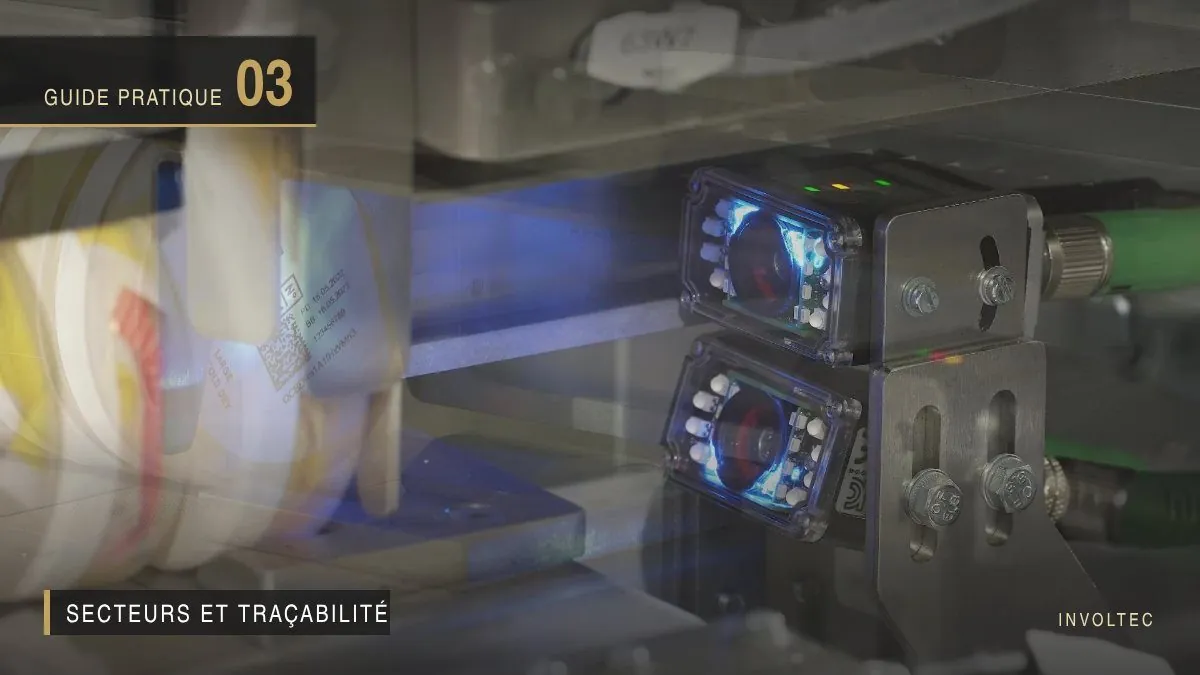
What regulations really require of a secondary packaging line, and what to put in the specification before choosing a machine.
The sector where the machine is only part of the picture
In most industries, a packaging machine is judged on what it produces.
In pharmaceuticals, it is also judged on what it can prove.
On top of the usual constraints of output, format and quality come regulatory obligations that apply directly to the machine, to the data it generates and to the documentation that accompanies it.
This difference has an immediate practical consequence: a pharmaceutical project is not scoped like a cosmetics or food project. The requirements must be set out from the specification stage. Adding them after installation always costs more, and often a great deal more time.
Read the rest of the guide
Enter your business contact details: you get immediate access to the whole of this guide and all INVOLTEC guides, on this device.
Coming up in the rest of the guide:
- Tamper evidence: an obligation first, a convenience second
- Serialisation: identifying every box, one by one
- Pouch packing: medical devices, single doses and kits
- Documentation counts as much as the machine
- The most common mistakes
- 10 questions to ask before launching a pharmaceutical project
- … and 1 more section
Tamper evidence: an obligation first, a convenience second
Delegated Regulation (EU) 2016/161, which supplements Directive 2011/62/EU on falsified medicines, requires boxes of prescription medicines to carry an anti-tampering device.
Overwrapping is one of the possible answers: a sealed material cannot be removed without leaving visible evidence.
This requirement shifts the quality focus. Seal consistency is no longer just a matter of appearance: it becomes a control point, with all that implies in terms of parameter setting, monitoring and recording.
In practice, this means:
- sealing parameters locked by authorisation level;
- traceability of recipe changes;
- formalised in-process checks;
- a defined procedure in the event of an observed drift.
Serialisation: identifying every box, one by one
The same regulation requires a unique identifier on each box, encoded as a Data Matrix and registered in a European repository.

For the line, this translates into four functions that must be performed flawlessly:
- printing the identifier on each box;
- reading and verifying it immediately after printing;
- aggregating the boxes into their shipping container;
- automatically and securely rejecting any non-compliant box.
The critical point is not printing. It is reject management and consistency between what was printed, what was read and what was reported. An untraced discrepancy across these three is a quality deviation.
Serialisation must therefore be designed as a function of the line, not as a module added at the end of the project.

Pouch packing: medical devices, single doses and kits
Not everything is packed in cartons.
Compresses, medical devices, single-dose sachets and kits are a matter for pouch packing, where two criteria come first: seal cleanliness and dosing consistency.
The choice of filler depends directly on the nature of the product — powder, granules, liquid or paste — and on the weight tolerance actually required by the applicable regulations. This topic is covered in detail in practical guide no. 10.
Documentation counts as much as the machine
On a pharmaceutical site, a machine is not judged on its performance alone.
The following are an integral part of the file:
- equipment qualification (installation, operational and performance qualification);
- setting and format changeover procedures;
- traceability of maintenance work;
- management of authorisations and access to the human–machine interface;
- documented operator training.
This last point is often dealt with last, even though it determines when the punch-list items can be cleared. INVOLTEC training courses are Qualiopi-certified (certificate no. CAP0869), so this upskilling can take place within a recognised framework that is eligible for funding.
The most common mistakes
Treating serialisation as an option. Added afterwards, it often means rethinking conveying, clearances and sometimes the complete layout of the workstation.
Underestimating reject management. A system that rejects correctly but does not trace its rejects does not meet the requirement.
Overlooking authorisation levels. A machine on which any operator can change a sealing temperature will be flagged during inspection.
Starting qualification too late. Documentation is prepared while the machine is being built, not after it is delivered.
Forgetting change control. Any PLC or HMI (human–machine interface) update on qualified equipment triggers a change control procedure, which must be planned in advance with the manufacturer.
10 questions to ask before launching a pharmaceutical project
- Which SKUs are subject to the anti-tampering device requirement?
- Is serialisation already in place upstream, or is it part of the project?
- How are rejected boxes removed, traced and destroyed?
- What level of aggregation do your customers and export markets require?
- Which machine parameters must be locked, and according to which authorisation levels?
- What is the expected scope of qualification, and who writes the protocols?
- Does production data need to be exported to an MES or ERP?
- What procedure is planned in the event of seal drift during a batch?
- Is operator training documented and archived?
- What is the change control process after qualification?
Conclusion
Three requirements shape a pharmaceutical project: tamper evidence, unit identification and documentary traceability. None of the three is easy to put right after installation.
Good practice is always the same: involve quality and maintenance in the specification, demand a FAT (factory acceptance test) that covers traceability as much as output, and allow for the time needed for qualification from the start.
A high-performing pharmaceutical line is not the one that produces fastest. It is the one that produces fast and can prove it.