
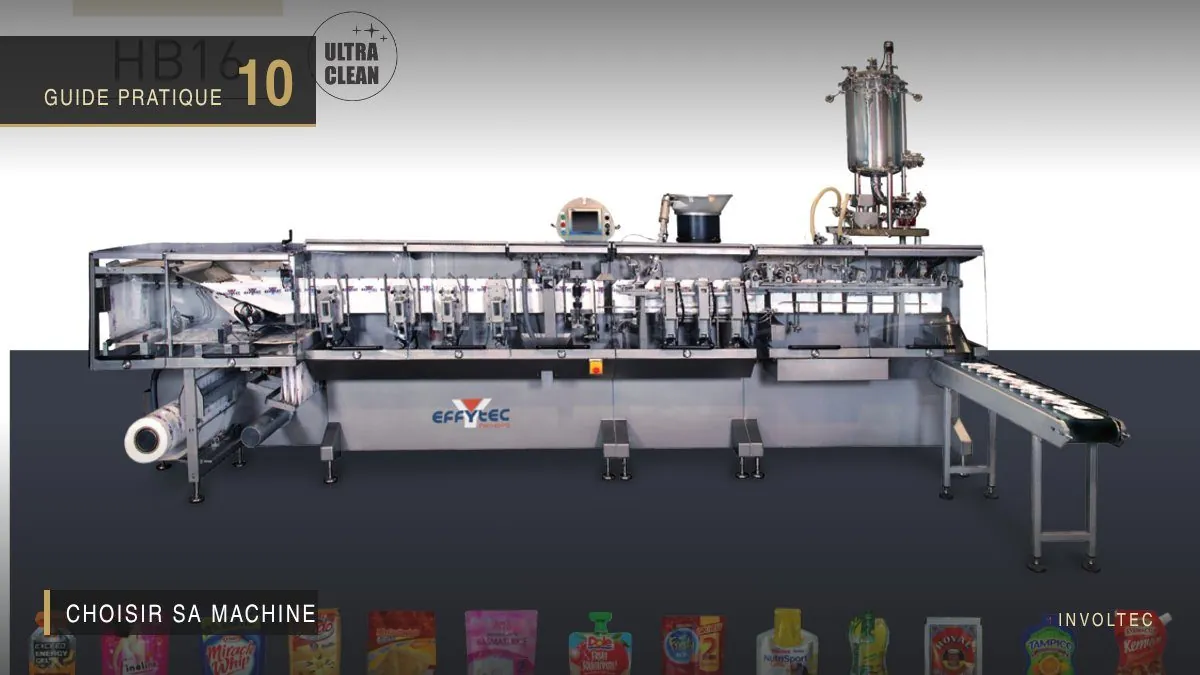
On a pouch line, the machine makes the sachet — but it is the filler that determines compliance.
The filler determines compliance, not the HFFS machine
On a pouch line, attention naturally focuses on the machine that forms, fills and seals the sachet.
Yet net weight, consistency and freedom from drift are all determined upstream of the seal.
Choosing a filler therefore starts with characterising your product: its nature, its flowability, its density and above all how stable that density is from one batch to the next.
Read the rest of the guide
Enter your business contact details: you get immediate access to the whole of this guide and all INVOLTEC guides, on this device.
Coming up in the rest of the guide:
- The auger filler: powders
- The volumetric cup filler: granules
- The piston filler: liquids and pastes
- Multi-ingredient configurations
- Integration with the HFFS machine determines the actual output
- The most common mistakes
- … and 2 more sections
The auger filler: powders
Auger fillers provide a uniform, progressive and controlled flow of powdered products.

Driven by electronically controlled servo motors and fitted with an agitator on an independent geared motor that limits dead zones, they are set directly on the screen: rotation speed and number of turns.
They are available in single, double, triple or quadruple versions depending on the dosing configuration required.
This is the benchmark solution whenever the product is fine, cohesive or prone to segregation.
The volumetric cup filler: granules
Made of stainless steel, volumetric telescopic cup fillers dose granular products by volume.
The bottom of each cup closes independently and the volume is set automatically from the screen. Single, double-discharge — two cups for a single sachet — and triple versions cover most configurations.
The volumetric filler is fast and robust. Its limitation is structural: it doses a volume, not a mass. Any variation in raw material density translates directly into a weight deviation.
This is the point to check before choosing one: does your raw material vary from batch to batch, and by how much?
The piston filler: liquids and pastes
Pneumatic piston in AISI 316 stainless steel, capacities of 100, 250, 500 and 1,000 cm³, interchangeable liners and seals.
A twin-hopper version can dose two products into the same twin-compartment sachet.
With pastes, two parameters deserve particular attention: the suction speed, which determines whether the chamber fills completely, and the circuit design, which determines how quickly it can be cleaned between two products.
Multi-ingredient configurations
Some recipes require several technologies to be combined at a single station: vibratory feeders, linear weighers, auger fillers or volumetric fillers.
This applies to mixes, kits and multi-component products, which are common in food (practical guide no. 4) as well as in medical devices and pharmaceutical single doses (practical guide no. 3).
These configurations require particular attention to synchronisation: the station will never produce faster than its slowest ingredient, and the overall tolerance is the sum of the tolerances of each lane.
Integration with the HFFS machine determines the actual output
INVOLTEC offers these fillers alongside EFFYTEC horizontal form-fill-seal machines, for direct integration on the customer’s line.

The actual output of the station is determined neither by the HFFS machine’s output nor by the filler’s, but by their synchronisation.
A filler that is faster than the HFFS machine serves no purpose; a slower one becomes the limiting factor for the whole line. It is the pair that must be sized, never one of the two in isolation.
The most common mistakes
Choosing the filler based on its stated output. It should be chosen based on the nature of the product and its variability; output comes second.
Ignoring raw material variability. A perfectly set volumetric filler will drift as soon as the product density changes.
Overlooking cleaning constraints. A filler that is hard to dismantle becomes a daily problem as soon as product changes are frequent or allergens are involved.
Sizing the filler and the HFFS machine separately. It is their synchronisation that determines the actual output of the station.
Setting the tolerance for convenience rather than according to regulations. Too wide a tolerance exposes you to non-compliance; too tight a tolerance cuts output for no benefit.
Four questions to ask before choosing
- What exactly is the product: powder, granules, liquid, paste or a mix?
- What weight accuracy is really required, and by which regulation?
- Does the raw material density vary from one batch or supplier to another?
- What are the cleaning constraints: frequency of product changes, allergens, quick dismantling, compatibility with cleaning agents?
Conclusion
A filler is chosen on the nature of the product and its variability, never on its stated output.
A poorly matched filler causes weight deviations whose annual cost far exceeds that of a station sized correctly from the outset.
And as with any packaging machine, validation is carried out with the actual product: a trial on representative material is worth more than a data sheet.