
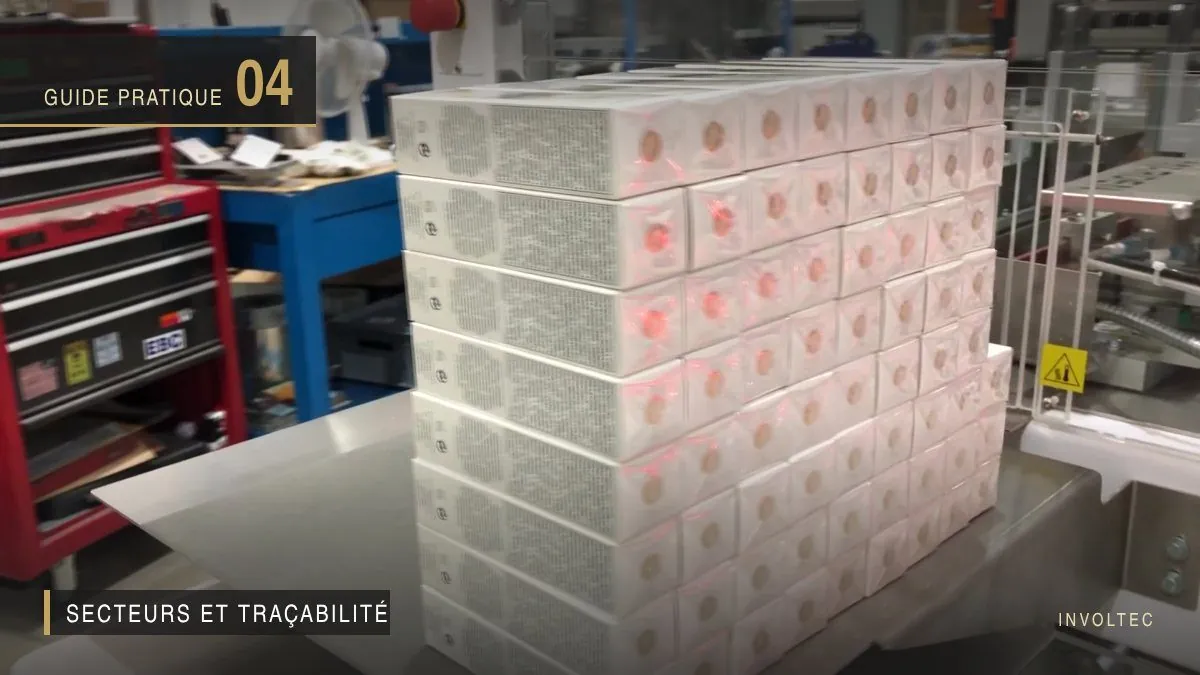
Three constraints rarely found together elsewhere, and which shape the architecture of a machine fleet far more than the advertised output.
Three constraints that add up
Food and confectionery place a trio of demands on secondary packaging that are rarely found together: strict hygiene rules, some of the highest output rates in industry, and pronounced seasonality.
Taken individually, each can be dealt with. It is their combination that makes these projects special, because it forces trade-offs: a machine optimised for very high output is not always the quickest to clean, and a machine sized for the year-end campaign will be under-used for the rest of the year.
It is this trade-off, not the choice of a model, that lies at the heart of the project.
Read the rest of the guide
Enter your business contact details: you get immediate access to the whole of this guide and all INVOLTEC guides, on this device.
Coming up in the rest of the guide:
- Hygiene shapes design, not just cleaning
- At high output, everything that was tolerable becomes critical
- Seasonality often decides the architecture of the fleet
- Pressure on plastic packaging has become regulatory
- And upstream: consistent dosing
- The most common mistakes
- … and 2 more sections
Hygiene shapes design, not just cleaning
Even when the machine does not come into direct contact with the food — as is the case with secondary packaging — the production environment imposes its own rules.
In practice, this concerns:
- contact materials, which must be cleanable and compatible with the site’s cleaning products;
- the absence of retention areas where dust, sugar and material scraps can build up;
- accessibility designed for cleaning, not just for maintenance;
- compatibility with the site’s food safety management plan and with customer audit standards.
This point should be clarified at the enquiry stage: it determines the machine’s options, its materials and its layout in the production area.
A machine installed in an area whose hygiene classification later changes becomes an issue in its own right. Better to ask the question once too often during the study.
At high output, everything that was tolerable becomes critical
Confectionery and fast-moving consumer goods often involve small formats in very long runs. The output rates reached there bear no comparison with those in cosmetics or pharmaceuticals.

Yet increasing output does not amplify problems proportionally: it changes their nature.
What becomes critical:
- dimensional variation of cartons from one batch to another;
- the actual condition of the change parts, not merely their presence;
- the consistency of the upstream infeed, which becomes the limiting factor;
- the cleanliness of photocells and sensors, whose fouling immediately results in stoppages;
- the stability of the product itself, which may be adequate at one output rate and no longer so at a higher one.
So the right question is not “what is this machine’s maximum output?” but “what output can it sustain for eight hours straight, with my product and my material?”
Seasonality often decides the architecture of the fleet
Easter, the festive season, promotional campaigns: the load on a confectionery line can vary threefold over the year.

Sizing production equipment for the peak means tying up capital that sits idle ten months out of twelve.
There are three complementary answers:
- renting a machine for the period of peak activity;
- acquiring an overhauled used machine to set up an additional line;
- organising a two-tier fleet, with one machine running continuously and another used only during campaigns.
In all three cases, the real issue is not the machine but planning ahead. Format tooling, material and trained operators must be available before the campaign starts, not during it.
Pressure on plastic packaging has become regulatory
The sector is on the front line of the packaging question, and the framework has fundamentally changed: Regulation (EU) 2025/40 on packaging and packaging waste, known as the PPWR (Packaging and Packaging Waste Regulation), has applied since 12 August 2026 and replaces Directive 94/62/EC. Its milestones are then staggered up to 2040.
Industrial alternatives exist: recyclable films, heat-sealable papers, 100% paper packaging with heat-activated adhesive.
But changing material is never neutral. Sealing windows differ, maximum speeds may be more limited and mechanical behaviour is often less forgiving.
The right approach is to test beforehand, on the machine and with the actual product, rather than finding out in production. Practical guide no. 6 details the families of materials and their conditions of use.
And upstream: consistent dosing
For products packed in sachets before cartoning — sugared almonds, powders, granules — consistent dosing determines net weight compliance.

The choice between an auger filler, a volumetric cup filler or a weigh filler depends on the nature of the product and above all on how much its density varies from one batch to another. A perfectly set volumetric filler will drift as soon as the raw material changes density. This subject is covered in detail in practical guide no. 10.
The most common mistakes
Sizing equipment for the seasonal peak. The capital tied up for the rest of the year almost always exceeds the cost of a rental solution or an additional machine.
Treating hygiene as a cleaning matter. It is a matter of machine design and layout, and therefore of the specification.
Comparing rated output figures. Only the output sustained under real conditions, with your product and your material, is meaningful for comparison.
Changing material without a production trial. Two very similar commercial grades can behave very differently in sealing and at speed.
Forgetting to train seasonal staff. An untrained campaign team alone generates a large share of start-up rejects.
Checklist: is your food-industry project properly scoped?
- ☐ Is the hygiene classification of the installation area defined, and stable over time?
- ☐ Are the contact materials compatible with your cleaning products?
- ☐ Has the stated output been measured with your product and your material?
- ☐ Has the ratio between peak load and average annual load been quantified?
- ☐ Has the format tooling needed for the campaign been ordered early enough?
- ☐ Are seasonal operators trained before the campaign begins?
- ☐ Have alternatives to plastic been tested under representative conditions?
- ☐ Is your PPWR compliance plan in place and phased?
- ☐ Is upstream dosing consistency monitored and recorded?
Conclusion
In food and confectionery, output is the most visible criterion but rarely the most decisive.
Hygiene decides the machine’s design, seasonality decides the fleet architecture, and packaging regulation now decides the timetable for material changes.
A well-scoped project addresses these three issues in the specification. A poorly scoped one discovers them during the first campaign.